Which Mattress for an Adjustable Base? What Bends Well and What to Avoid

On an adjustable base, you need a mattress that bends with the base without losing its shape. Foam, latex and pocket coil mattresses work, because their layers or coils move independently. Continuous coil mattresses, whose springs are all linked by the same wire, bend less easily and are usually not recommended. A one-sided mattress of medium thickness follows the movement more easily than a thick two-sided one.
An adjustable base raises the head, the feet, or both, with a remote. Our SmartFlex bases work this way, with a wireless remote. The mattress on top has to follow those movements every day for years. Here is how to choose one that will do it well.
What an adjustable base asks of a mattress
When the head rises, the mattress bends in two places: under the hips and where the sections of the base meet. To work well, it has to:
- bend without resisting, so it takes the shape of the base instead of bridging over it;
- return to flat, without keeping a crease once the base comes back down;
- stay in place, without sliding toward the foot of the bed when the head is raised;
- keep proper support when sitting up, since that is often the position for reading or watching TV.
The materials that work
Foam
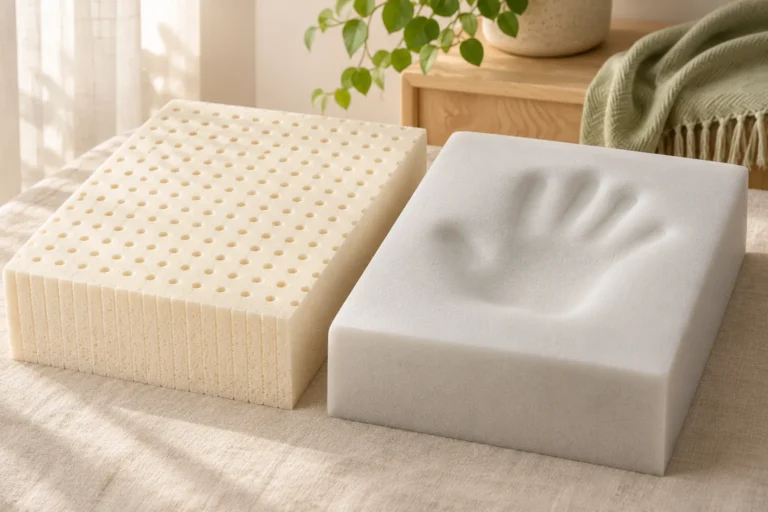
A foam mattress is a stack of flexible layers with no rigid part. It bends easily and returns to flat. It is the simplest construction to pair with an adjustable base. Our foam mattresses are made of high-density or extra-dense foam, with comfort layers you choose.
Latex
Natural latex is very flexible and elastic: it follows the bend of the base and returns to flat without leaving a mark. Our Talalay 8 inch is all latex, and L’ultime and the Lucern Plus place Talalay latex layers on a foam base.
Pocketed coils
In a pocket coil mattress, each spring is sewn into its own pocket and works on its own. The support can therefore bend where the base bends, without pulling the rest along. Our Caress, Summum and Le Supreme models rest on this type of support, with a firm-foam perimeter that keeps the edge solid when you sit on it.
The construction to avoid: continuous coil
In a continuous coil support, the springs are formed from a single steel wire that runs from one end of the mattress to the other. That is what gives a firm, uniform surface on a flat bed. On an adjustable base, this linked structure resists bending more, which is why it is generally not recommended for this use.
Our Signature and Chiro Comfort models use a continuous coil. They are good mattresses on a flat bed. If you already own one and are thinking of buying an adjustable base, talk to us first: we will tell you honestly what is realistic.
To understand the other differences between these constructions, see our guide to foam or spring mattresses.
Thickness, and one-sided or two-sided builds
The thicker a mattress is, the more it resists bending. A very thick mattress can bridge slightly instead of following the base, especially at the hips. A mattress of medium thickness follows the movement better.
Our foam and latex mattresses are made one-sided and measure 7.5 to 9.5 inches in total, a thickness that follows the bend well. Our pocket coil models come one-sided, at 11 to 12 inches, or two-sided, at 14 to 16 inches. On an adjustable base, choose the one-sided version: it bends more easily, and the advantage of the two-sided model, being able to flip it, matters less when the mattress sits on a base that always bends in the same place.
The practical details
- The retainer bar. Most adjustable bases have a bar at the foot of the bed that keeps the mattress from sliding when the head is raised. Check that it is in place when the base is set up.
- No box spring. The mattress sits directly on the adjustable base. The base replaces the traditional box spring.
- The zippered panel. Most of our mattresses have a zippered comfort panel. It lets you change a layer later, for example if you want a softer surface now that you read sitting up in bed.
- The edge. If you often sit on the edge of the bed, a reinforced perimeter helps. Our Caress, Summum, Le Supreme and L’ultime models have one.
What about couples?
On a one-piece adjustable base, both sides rise together. If each person wants to set their own position, you need a base split in two, with a mattress for each side. The size of the two mattresses then depends on the base. Since we also make made-to-measure mattresses, tell us the dimensions of your base: we will tell you which options are possible.
The two sides do not need the same firmness either. Our guide to firm or soft mattresses helps you choose based on how you sleep.
Frequently asked questions
Can you put any mattress on an adjustable base?
No. Most foam, latex and pocket coil mattresses work. Continuous coil mattresses and very thick mattresses follow the bend less well. Our SmartFlex bases are compatible with most standard mattresses, but the mattress itself also has to be able to bend.
Can a spring mattress go on an adjustable base?
Yes, if it has pocket coils. Each spring works on its own, so the support bends where the base bends. Continuous coil springs, which are linked together, are generally not recommended.
Does an adjustable base wear out the mattress faster?
A suitable mattress, in foam, latex or pocket coils, is made to bend. What wears it out is mostly a mattress that is too stiff or too thick being forced to follow the base. Choosing the right construction from the start is still the best protection.
Foam or latex on an adjustable base?
Both work well. Foam is lighter and gives a more stable feel; latex is more elastic and lets air circulate more freely. Our guide on latex vs memory foam compares how they feel in detail.
Try the mattress and the base together
The safest approach is to choose both at the same time. Browse our SmartFlex bases and our three mattress collections:
Then come and try them in our stores. You can also write to us or call us at 514 725-1000 to check a mattress you already own.