Firm or Soft Mattress: How to Choose the Right Feel
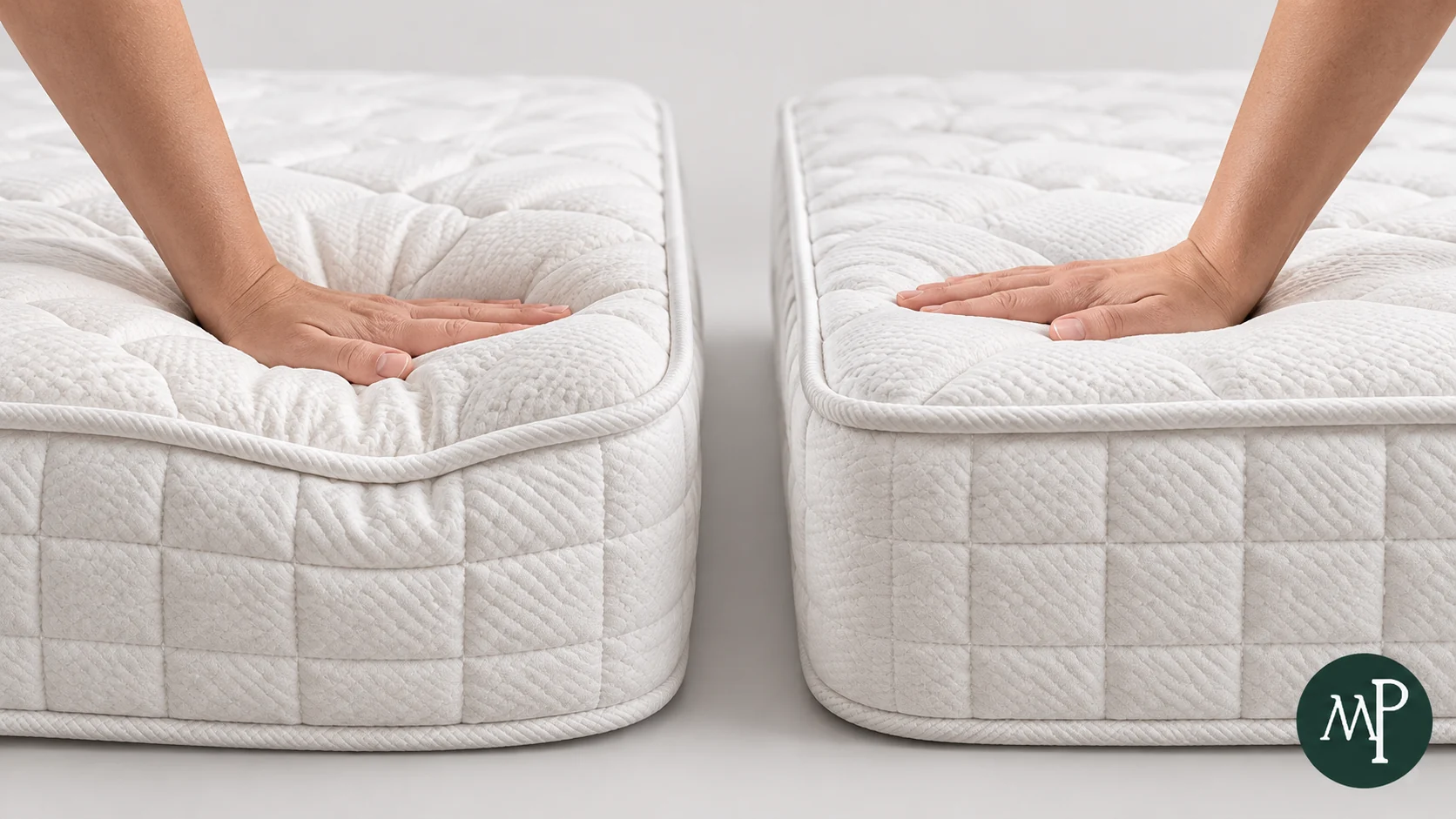
A firm mattress and a soft mattress are not separated by how much support they give, but by how far your body sinks before something holds it. Both can support you properly and both can fail to. What decides it is your weight and the position you spend the night in, not the preference you think you have after sitting on a showroom bed for two minutes.
We build every model in three firmness levels in our Saint-Leonard workshop, which means we see what comes back: who gets it wrong, in which direction, and why. The direction of the mistake is almost always the same, and this guide covers how to avoid it.
The short version
- Firm does not mean well supported. A mattress supports you well when it keeps your spine aligned.
- The same mattress does not feel equally firm to two people of different weights.
- On your side, aim soft to medium. On your back, medium to firm. On your stomach, firm.
- The most common mistake is buying too firm, by reflex, in the belief that it protects your back.
- Labels are not standardised: one maker’s soft is another maker’s medium.
Firmness and support are not the same thing
This is the confusion behind most bad purchases. Firmness is a sensation: what you feel in the first few seconds, as the surface gives way or resists. Support is an outcome: does your spine stay in the same curve it has when you are standing, yes or no. A soft mattress with a dense support layer underneath supports you very well. A hard mattress with no structure underneath supports you badly while still feeling firm.
Put another way, you choose firmness for your immediate comfort and construction for your long-term support. Those are two separate decisions, and mixing them up is what leads someone to buy the hardest board in the shop believing they are doing the right thing.
The table to use: your weight crossed with your position
Firmness is not a property of the mattress on its own, it is what happens when your mass meets the surface. Someone who weighs 55 kg and someone who weighs 100 kg lying on the same model are not sleeping on the same thing. Here is the starting point we work from in the workshop.
| Your build | Side sleeping | Back sleeping | Stomach sleeping |
|---|---|---|---|
| Under 60 kg | Soft | Soft to medium | Medium |
| 60 to 90 kg | Soft to medium | Medium | Medium to firm |
| Over 90 kg | Medium | Medium to firm | Firm |
This table is a starting point, not a verdict. If you fall between two boxes, go down a step rather than up: it is far easier to firm up a surface that is too soft by putting it on a rigid base than it is to soften one that is too hard.
What actually changes inside
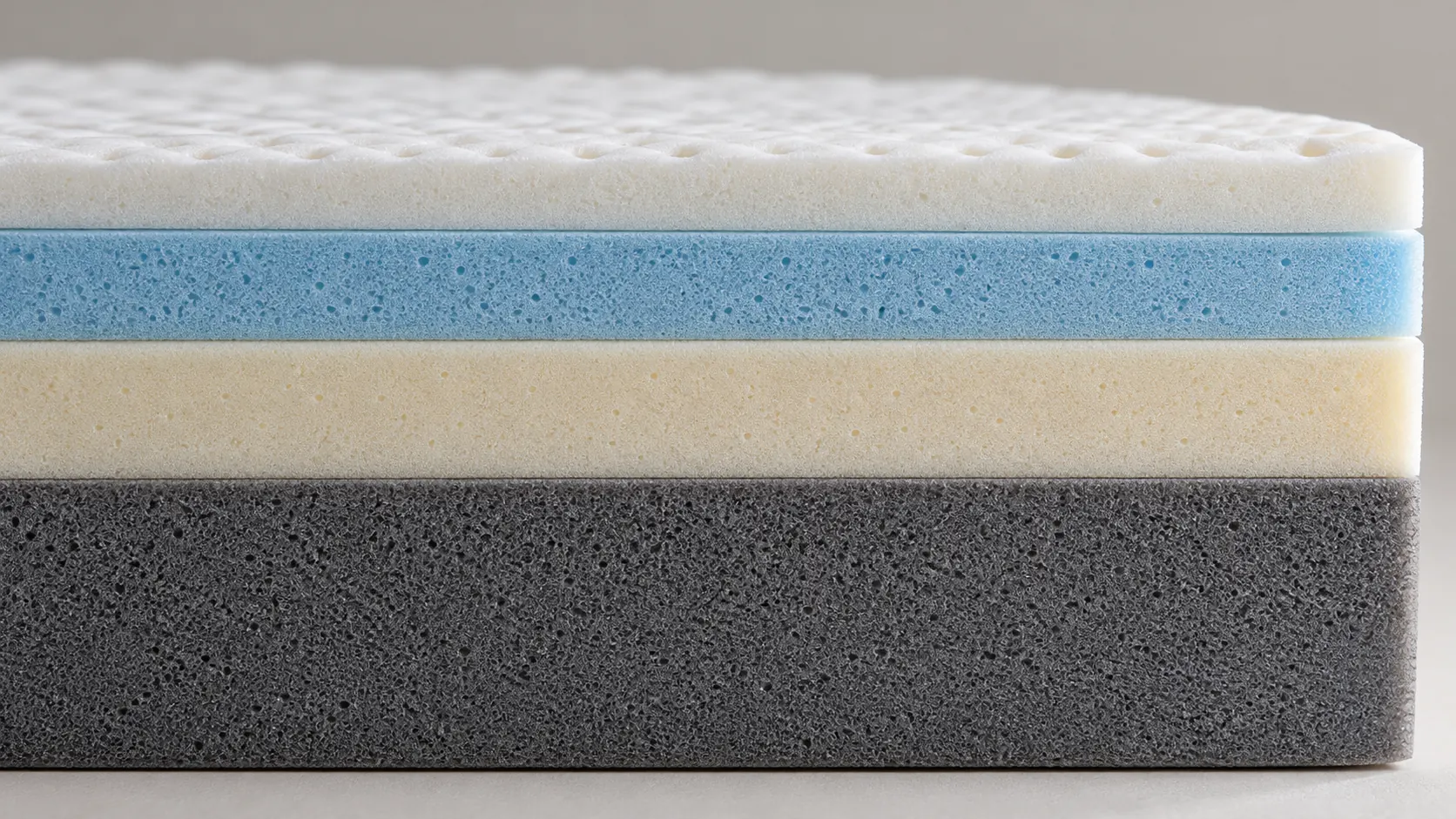
When we build the same model in soft, semi-firm and firm, the support layer does not change. That layer is what carries your body and sets how long the mattress lasts, and it is identical across all three versions. What changes is the comfort layers above it: how thick they are and the density of the foam used.
That has a useful practical consequence: changing firmness does not mean changing quality. A soft version is not a cheap version, and a firm version is not a reinforced one. It is also why you do not need to switch models because the firmness turned out to be wrong.
Why the labels do not mean much
There is no mandatory commercial standard defining what a firm mattress is. Each manufacturer puts its scale where it likes, and two mattresses both labelled medium can sit two steps apart. A technical scale does exist, the hardness scale used in Europe, but it almost never appears on a showroom label.
The practical consequence: compare within a single brand, never between two brands on the strength of the word alone. And if you have to rely on one figure, rely on the stated density of the support foam rather than the adjective.
The test that actually works
Lie down in your usual position, not on your back out of politeness, and stay there for at least ten minutes. Then slide a flat hand under the hollow of your lower back. If it slides in with no resistance at all, the mattress is too firm for you. If you cannot get it in at all, it is too soft. If it goes in with a little effort, you are in the right place.
A second test, if someone is with you: ask them to look at your spine from the side while you lie on your flank. The line from the back of your neck to your tailbone should be roughly straight. If your hips dip, it is too soft. If your waist hangs unsupported in the air, it is too firm.

Sharing a bed with two preferences
When two people share neither a weight nor a sleeping position, the compromise is almost always paid for by the lighter one, because they are the person who feels the support least. Setting firmness for the heavier person and adding surface comfort for the other works better than aiming for the middle, which often suits neither of them.
In a large enough room, the cleanest answer is still two twin mattresses side by side on a shared base. Each person picks their own firmness, neither feels the other move, and King-size sheets cover the whole thing.
If you got it wrong
Give it two to four weeks first. Your body is used to the shape of the old mattress, dips included, and that reference point takes a while to fade. If the discomfort is still there after a month, it is no longer an adjustment period.
Too firm can be corrected reasonably well: a mattress topper of decent thickness adds the comfort layers that are missing. Too soft cannot be corrected from above. Check the base first, because a sagging base or one with widely spaced slats will make a new mattress dip within months and produces exactly the same sensation as a mattress that is too soft.
How we approach it
Every one of our models comes in soft, semi-firm and firm, with the same support layer in all three. Our mattresses are built in Saint-Leonard using high-density foam, gel foam, pocketed coils, continuous coil, Talalay natural latex, organic cotton and natural wool. The usual lifespan across the trade is 7 to 10 years; ours are designed to last 20.
If you are torn between two steps, call us at 514-725-1000 with your weight and your sleeping position: those are the only two pieces of information we need to point you in the right direction. You can also compare models in the shop , or take the decision from the top with our guide on how to choose a mattress.
Frequently asked questions
Is a firm mattress better for your back?
No, and it is the most expensive myth in the trade. A clinical trial published in The Lancet in 2003 compared firm and medium-firm mattresses in 313 adults with chronic low back pain, and the medium-firm group did better. That does not mean a mattress treats anything, only that the reflex of buying the hardest one available is not supported by the data.
We have given this question a guide of its own, including the caveats the study imposes and the symptoms that belong with a professional: mattresses and back pain. The original Kovacs trial can be consulted on PubMed.
Does a soft mattress sag faster?
Not because of its firmness. What sags is a low-density support layer, and that can happen under a firm mattress just as easily as under a soft one. With us, the support layer is identical across all three firmness levels, so the choice has no effect on how long the mattress lasts.
Can you soften a mattress that is too firm?
Yes, partly, with a topper. Count on at least 5 cm of real thickness for it to make any difference; below that you are adding a layer of fabric and nothing more. It will not turn a firm mattress into a soft one, but it is often enough to go from uncomfortable to acceptable.
Does firmness change with room temperature?
With foams, yes, noticeably. Memory foam softens in heat and stiffens in cold, which is very obvious in a basement bedroom in Montreal in January. Latex and coils are far more stable from one season to the next.
How long does it take to get used to a new firmness?
Two to four weeks in most cases. The change is sharper when you move from an old, hollowed-out mattress to a new one, because you lose a dip your body had adapted to. If nothing improves after a month, the firmness is wrong.
Is semi-firm the safe choice?
It is the choice that suits the largest number of people, which is why it sells the most. But if you consistently sleep on your side and have a small frame, semi-firm will be too firm for you, and soft is the right answer. Safe here is not the middle: it is the box that matches your row in the table above.