
How to Choose a Mattress: The Criteria That Actually Matter
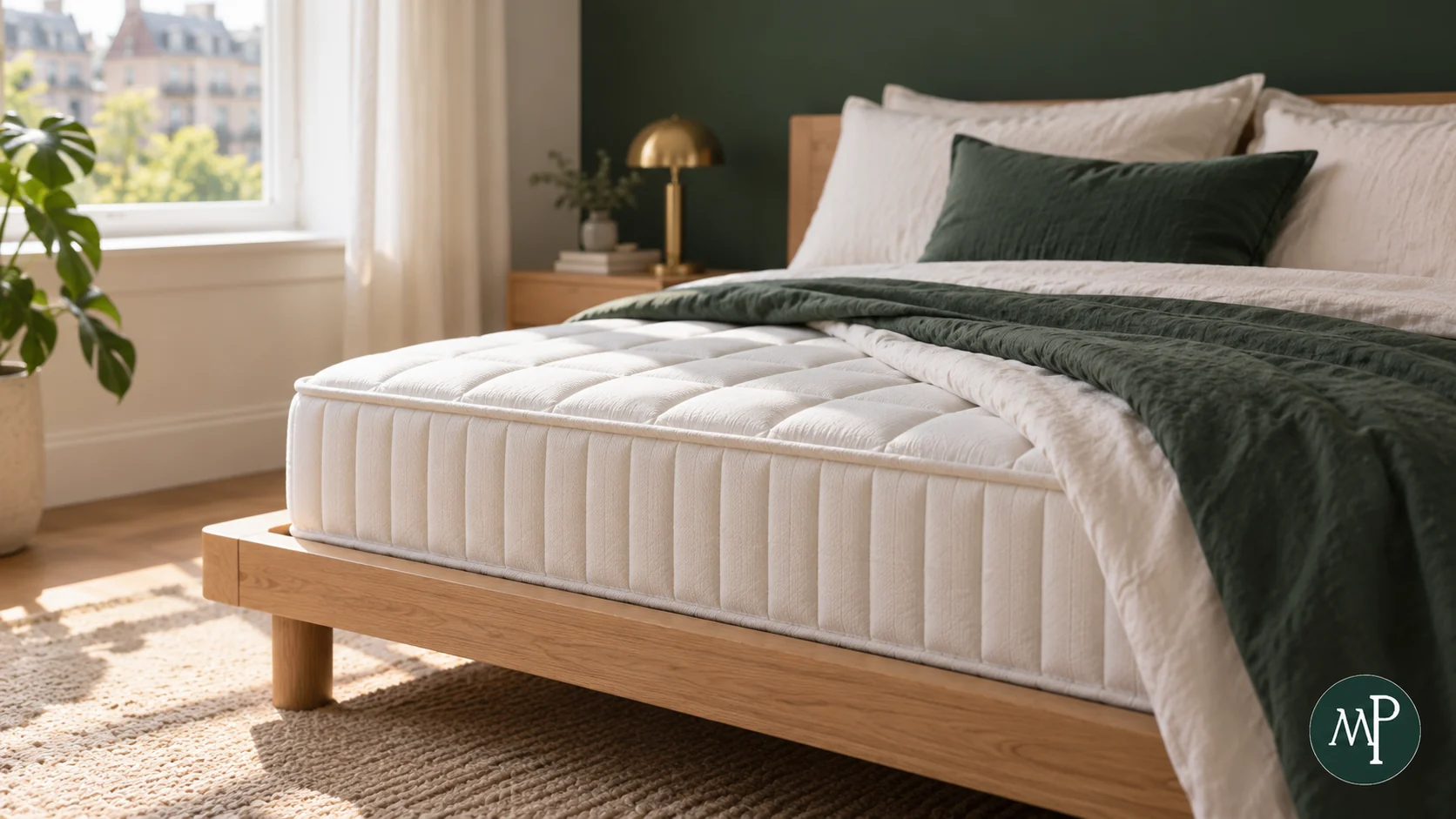
Choosing a mattress starts with three things you already know: the position you fall asleep in, your weight, and the real dimensions of your bedroom. Those three things decide the support you need. Brand names, advertised layer counts and marketing vocabulary matter far less.
We build mattresses in Montreal and we see the same mistakes over and over. Someone buys something too firm because they were told a firm mattress supports the back better. Someone else buys the biggest bed that fits and then cannot walk around it. This guide covers how to avoid both, and what to look at instead.
The short version
- Side sleepers need the shoulder and hip to sink in. Aim for soft to medium support.
- Back sleepers need the hollow of the lower back filled. Aim for medium to firm support.
- Stomach sleepers need the hips to stay level with the shoulders. Aim for firm support.
- The heavier you are, the further you sink into the same surface. One mattress does not feel equally firm to two people of different weights.
- Measure the room before you pick a size, and leave at least 60 cm to walk on one side.
Start with your sleeping position
The position you spend the night in decides the shape the mattress has to take. A good mattress keeps your spine in roughly the same alignment it has when you are standing. What changes from one position to the next is where the body needs to sink in and where it needs to be held up.
If you sleep on your side
On your side, the shoulder and the hip are the two widest points of your body. If the surface is too firm, neither one sinks in and your waist hangs unsupported. You wake up with a numb shoulder and you shift position all night. You need a surface that gives way at those two points while still holding the waist up.
If you sleep on your back
On your back, the problem is reversed. The pelvis is heavy and drops easily, while the hollow of the lower back touches nothing at all. A surface that is too soft lets the pelvis sink and deepens that hollow further. A surface that is too firm leaves a gap under the lower back. The right answer is almost always in the middle of the scale.
If you sleep on your stomach
Stomach sleeping is the position where a soft surface causes the most trouble. If the hips sink lower than the shoulders, the spine arches for seven or eight hours straight. It is the only position where we recommend the firm end of the scale from the outset.
Your weight matters as much as your position
This is the part most people skip. Firmness is not a property of the mattress on its own, it is the result of the mattress meeting you. Two people thirty kilos apart lying on the same model are not sleeping on the same thing: the heavier one presses through the comfort layers and feels the support layer underneath, the lighter one stays on the surface and finds the mattress hard.
One practical consequence: if you have a small frame, a mattress described as medium will often feel firm to you, and you should drop a step. If you have a larger frame, a mattress described as soft is likely to bottom out under you, and you are better off moving up a step and looking for a denser support layer.
How to pick firmness without guessing
The words used in the trade are not standardised. One manufacturer’s soft is another one’s medium. Instead of trusting the label, cross your sleeping position with your weight, then check against the mattress itself.
The test that works: lie down in your usual position, not on your back out of politeness, and stay there for at least ten minutes. Then slide a flat hand under the hollow of your lower back. If it goes in with no resistance, the mattress is too firm for you. If you cannot get it in at all, it is too soft. If it goes in with a little effort, you are in the right place.
Foam, springs or latex: what the construction changes
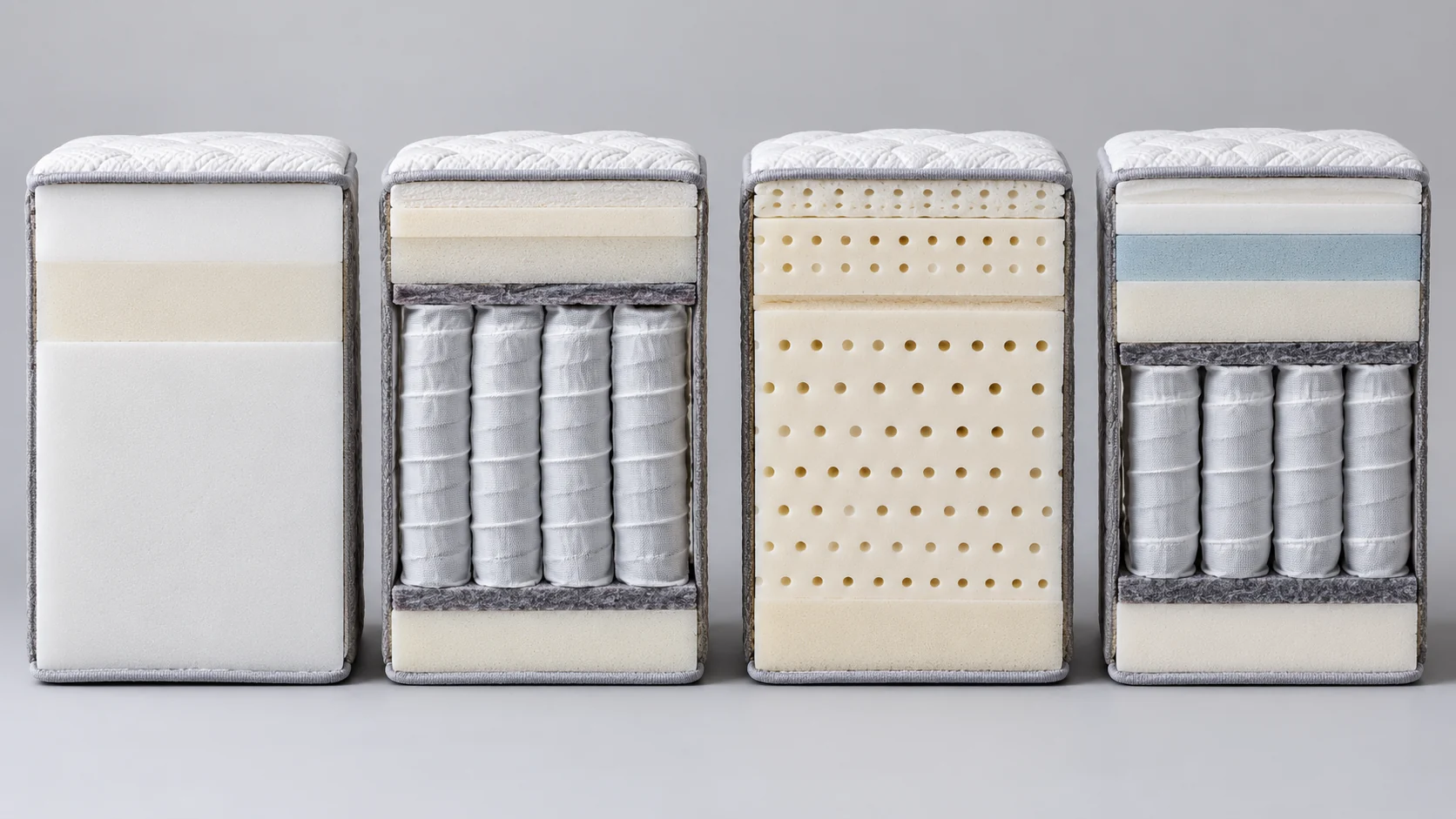
The construction does not decide firmness, it decides the feel and the way the mattress behaves over time. Here is what each family actually does.
| Construction | What it feels like | Who it suits |
|---|---|---|
| High-density foam | A surface that cradles you, with very little motion transfer | Couples where one person wakes when the other moves |
| Individually pocketed coils | Point-by-point support with more bounce and better airflow | People who find foam too warm or too soft |
| Natural Talalay latex | An immediate springy response, the surface recovers at once | People who change position often during the night |
| Hybrid construction | A coil core with comfort layers built on top | People who want coil support and foam comfort together |
If you are still weighing two families against each other, our detailed comparison of foam and springs goes through every difference in turn, and our natural latex mattresses show what the third option looks like.
Memory foam, high-density foam or gel foam
These three foams get confused with one another and they do not do the same job. Memory foam, also called viscoelastic foam, reacts to body heat and slowly hollows out where you press on it. It cradles you closely, it absorbs movement well, and it has two known drawbacks: it holds heat, and it loses its shape faster than other foams when its density is low.
High-density foam is firmer and more structural: it is the layer that carries your body and decides how many years the mattress will hold up. Gel foam is foam with gel worked into it to move heat away more effectively. In our mattresses the support layer is high-density foam, and gel foam is what we reach for when heat needs managing. The density figure will always tell you more about durability than whatever trade name the foam has been given.
Thickness, and what it does not tell you
A thicker mattress is not automatically a better one. What matters is how the thickness is distributed: a 30 cm mattress with 20 cm of soft filling will age faster than a 20 cm one with a genuine dense support layer. That said, thickness has one practical consequence people forget: your fitted sheets have to reach around it. Past roughly 35 cm, ordinary sheets stop staying on. Measure before you buy sheets, not after.
One-sided or two-sided
A one-sided mattress can be turned head to foot but not flipped over: only one surface is built to sleep on. A two-sided mattress flips completely, which spreads the wear across two surfaces instead of one. The second costs more to build because it contains more material, and it asks one extra piece of upkeep from you.
The choice mostly depends on your habits. If you know you will never flip a mattress, a well-built one-sided model will serve you better than a two-sided one that never gets flipped. If you are willing to do it twice a year, the two-sided version ages more slowly.
Size: measure the room, not just the bed
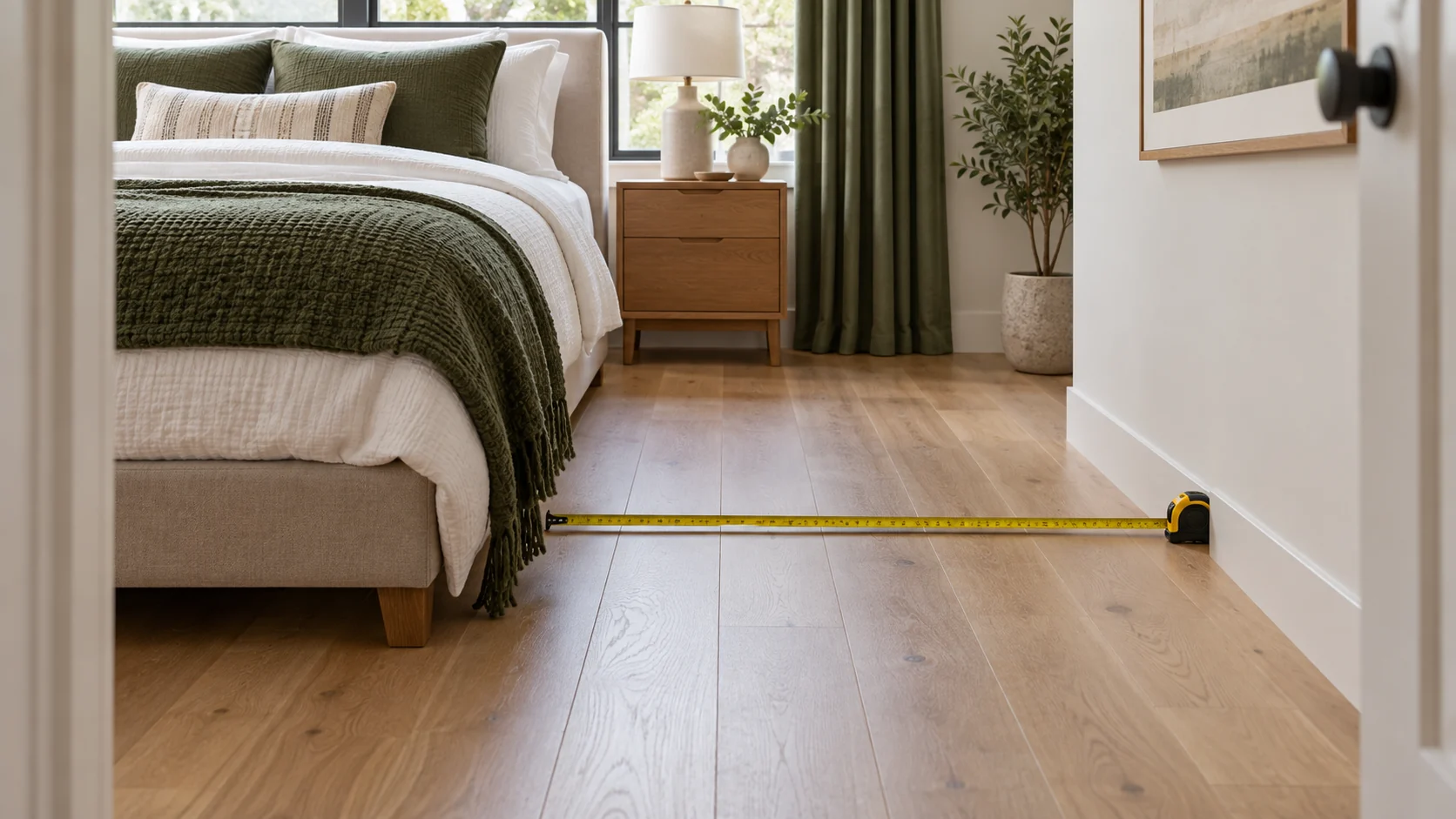
The most common mistake is picking the largest size that physically fits the room. A bed touching two walls is hard to make, hard to walk around at night, and leaves the room useless for anything else. Allow at least 60 cm of clear floor on one side, and check the route in as well: spiral staircases, narrow stairwells, tight corridor corners.
Our mattress size guide lists the exact measurements of every format in inches and centimetres. If no standard format suits your room, we also build mattresses built to measure to the dimensions you give us.
Sharing a bed when you do not sleep alike
When two people share neither a sleeping position nor a weight, the compromise almost always costs the lighter person, because they are the one who feels the support least. Two things genuinely help: choosing pocketed coils or high-density foam to limit motion transfer, and setting firmness for the heavier person while adding surface comfort for the other.
In a large enough room, the simplest answer is still two twin mattresses side by side on a shared base. Each person picks their own firmness and neither one feels the other move.
The questions to ask before you buy
- What is the support layer made of, and how dense is it?
- Is the mattress one-sided or two-sided?
- Where is it built, and by whom?
- Which firmness levels exist for this same model?
- What happens if the firmness turns out to be wrong once it is at home?
- Does the format come in a width that suits my room?
What budget to plan for
This is the question nobody asks the salesperson and everybody wonders about. Here are our own ranges in Queen format, from the most accessible model to the most elaborate in each family. They give you a realistic order of magnitude for a mattress built in Quebec rather than imported.
| Mattress family | Queen format range | What drives the price up |
|---|---|---|
| Spring mattresses | $680 to $1,160 | The coil count and the quality of the padding |
| Foam mattresses | $930 to $2,410 | Foam density and whether it is one-sided or two-sided |
| Hybrid mattresses | $1,395 to $2,695 | The coil type combined with the depth of the comfort layers |
| Latex mattresses | $2,420 to $3,560 | How much natural latex is used and how thick it is |
One simple rule if your budget is tight: put the money into the support layer before you put it into the finish. An embroidered ticking will not help you sleep better eight years from now, dense foam will. The prices shown on our product pages are always the current ones, and you can compare them family by family in the shop.
Boxed mattress or made-to-order mattress
A boxed mattress is compressed, rolled and shipped in a carton. The advantage is real: it fits up a narrow staircase and it arrives quickly. So is the trade-off. To be compressible, a mattress has to be almost entirely foam, which rules out coil constructions and limits how much latex can be used. It is also sold in a fixed set of standard formats, which does not help you if your room has a constraint.
A made-to-order mattress starts from the opposite problem: you choose the construction and the format first, and work out the logistics afterwards. If your room is a standard size and you want foam, the box does the job. If you want coils, latex, two sleeping surfaces, or a width that no shop stocks, the box cannot give you any of that.
How we approach it
We build our mattresses ourselves in Saint-Leonard, using high-density foam, gel foam, pocketed coils, continuous coil, Talalay natural latex, organic cotton and natural wool. Every model comes in more than one firmness, which means you do not have to change models because the firmness is wrong.
The lifespan quoted across the trade sits between 7 and 10 years. Ours are designed to last 20. That changes how you should choose: over that span, the quality of the support layer matters far more than the price on the day you buy.
If you would rather talk it through before deciding, call us at 514-725-1000 or look through the models in our online shop.
Frequently asked questions
Which mattress should I choose if my back hurts?
We cannot tell you that a mattress treats anything, and nobody should tell you that. What we can say is that a mattress which lets the hips sink below the shoulders holds your spine out of alignment all night. If you have persistent pain, speak to a health professional first, then come to us with whatever they recommended in terms of support.
Is a firm mattress better?
No. Firm is not the same thing as well supported. A mattress supports you well when it keeps your spine aligned, and for a side sleeper that requires a surface that gives way at the shoulder and the hip. Buying the firmest thing available is the single most common reason people are unhappy with a mattress three months later.
How long does it take to get used to a new mattress?
Give it two to four weeks. Your body is used to the shape of the old mattress, dips included, and it takes a little time for that reference point to fade. If the discomfort is still there after a month, it is no longer an adjustment issue: the firmness is wrong.
Should I replace the base at the same time as the mattress?
Check it before you decide. A sagging base, or one with slats spaced too far apart, will make a new mattress dip within months, and the problem will look like it comes from the mattress. Lay a straight edge or a long level across the base: if you can see light under the middle, replace it.
Can you choose a mattress without trying it?
Yes, if you know what to ask. Sleeping position, weight and the construction of the support layer already take you very close to the right choice. A few minutes on a showroom bed is less reliable than people assume anyway, because ten minutes on your back tells you nothing about seven hours on your side.
How often should a mattress be replaced?
The signal to watch is not age but the imprint: the day the hollow left by your body stops disappearing in the morning, the support layer has given out. We covered the six signs to watch for in our article on how long a mattress lasts.

