Foam vs Spring Mattress: How to Choose for the Way You Sleep

Foam and spring mattresses fail in opposite directions, and that is the useful way to choose between them. A foam mattress absorbs movement and wraps around the body. A spring mattress pushes back, breathes better, and is easier to move around on. Neither is the better construction. One of them is the better match for how you sleep.
We build both in Montreal, so we have no reason to sell you one over the other. What follows is the comparison we actually walk customers through: what differs mechanically, how each one feels after a few months, and which sleeper each construction suits.
The short answer
- Sleep hot, or share the bed with someone who does? Coils move more air.
- Woken by a partner turning over? Foam absorbs movement better than any coil unit.
- Side sleeper with pronounced hips and shoulders? Foam gives way where you need it to.
- Back or stomach sleeper, or heavier build? Coils hold the middle of the bed up longer.
- Sit on the edge of the bed every day? Ask about the perimeter before anything else.
- Want the bounce of coils with the surface of foam? That is what a hybrid is for.
If you only remember one thing: foam is chosen for how it contours, coils are chosen for how they support and breathe.
Foam mattress versus spring: what actually differs
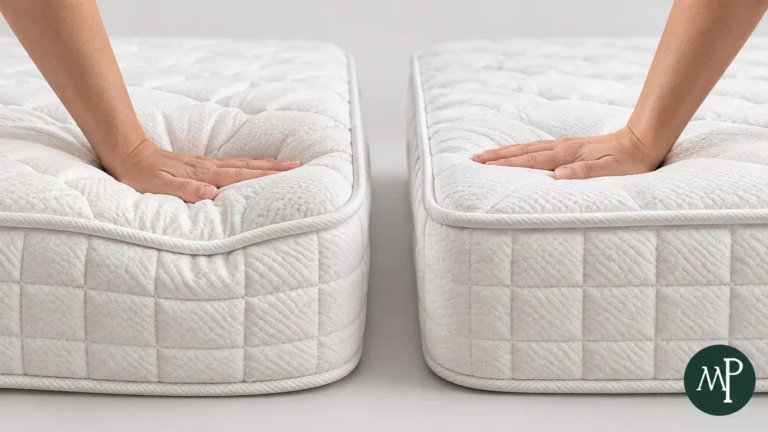
Most of the differences people describe as feel come from one mechanical fact. Foam is a single continuous material that compresses. A coil unit is hundreds of separate springs with air between them.
| Criterion | Foam mattresses | Spring mattresses |
|---|---|---|
| Movement from a partner | Absorbed almost entirely, since the material does not transmit it | Reduced by pocketed coils, more noticeable with a continuous coil unit |
| Air circulation | Less air moves through a solid block, so it holds heat closer to the body | The space between coils lets air move, which is why coils tend to sleep cooler |
| Contour | Gives way under hips and shoulders and follows the body’s shape | Supports in zones rather than moulding, unless the comfort layer does it |
| Getting in and out | You sink in slightly, so changing position takes a little more effort | The unit pushes back, which makes turning over and getting up easier |
| Perimeter | Depends entirely on the density of the foam used at the edge | Depends on whether the coil unit has a reinforced border |
| Noise | Silent by construction | Silent when new; a worn unit can develop a creak |

Notice how many of the rows end in a condition rather than a verdict. That is the honest state of this comparison: within each family, build quality changes the answer more than the family itself does.
You can see how we build each of the two: foam mattresses on one side, spring mattresses on the other, with the materials used in each case.
How each one feels to sleep on
Sharing the bed
This is where foam wins most clearly. A solid material does not carry a movement across to the other side, so a partner getting up at five in the morning does not register. Pocketed coils are the coil answer to the same problem, because each spring is sewn into its own fabric pocket and compresses on its own. They are good. Foam is still better.
Heat
Coils put space inside the mattress, and air moves through that space when you shift position. A foam core has no such gaps, so it keeps heat nearer the surface. Gel foam is made to address exactly this, and the cover matters as well: organic cotton and natural wool manage moisture very differently from a synthetic knit. If overheating is your main complaint, this is worth more of the conversation than the foam-or-coil question itself.
Support in the middle of the bed
Under a heavier load, a coil unit distributes force across a structure while foam relies on its own density to resist compression. Well-specified high-density foam handles this without trouble. Under-specified foam is where the classic centre-of-the-bed hollow comes from. For a couple, or for a heavier sleeper, coils are the more forgiving choice if you cannot verify the foam density.
The edges
Almost nobody asks about this, and it is the part of the mattress that annoys people most. The edge takes your full weight on a small area every time you sit down to get dressed. A reinforced coil border and a high-density foam perimeter both solve it. The absence of either shows up within a couple of years, whichever family you chose.
Responsiveness
Coils give back. Foam takes a moment to release. Some people read that delay as comfort and some read it as being stuck, and there is no arguing anyone out of their preference. It is the single most reliable thing to test with your own body rather than on paper.
Which one lasts longer
The family does not decide this. The weakest layer does.
In a foam mattress it is the density of the support foam. In a spring mattress it is almost always the comfort layer above the coils, not the coils themselves, which is why a good coil unit under cheap padding still feels tired after a few years. A mattress off a showroom floor generally lasts 7 to 10 years, and we design ours to last 20, which comes down to those specific choices: denser foams, more serious coil units, and comfort layers that do not compact after three winters.
The signs that a mattress is finished are the same in both families. We go through them one by one in our guide on how long a mattress lasts, including the test that settles it.
Where latex and hybrids fit
Framing the choice as two options leaves out the two constructions that often resolve it.

Natural latex behaves like a responsive foam. It contours, but it releases immediately instead of holding the impression, and of the materials we work with it is the one that keeps its shape longest. Talalay latex is the version we use. It is the answer for someone who wants foam’s surface without foam’s slow release.
A hybrid puts a coil unit underneath and foam comfort layers on top, so you get airflow and push-back from below with contour at the surface. It is the most common resolution when two people in the same bed want different things.
Both are worth comparing directly: latex mattresses for how they hold up over time, and hybrid mattresses for the combination of both approaches.
How to choose between foam and spring
You sleep on your side
Your hips and shoulders carry the load on a narrow surface, so the mattress has to give way at those two points and hold everywhere else. Foam does that naturally. Pocketed coils with a proper comfort layer do it too. A firm continuous coil unit with thin padding is the combination to avoid.
You sleep on your back or your front
Here the priority reverses: you want the middle of the mattress to stay up rather than cradle you. Coils, or a genuinely high-density foam. Soft foam is what produces the sagging middle that front sleepers notice first.
You sleep hot
Start with coils or a hybrid, then look at the comfort layer and the cover, which is where most of the heat is actually managed. Gel foam exists for people who want a foam surface anyway.
You and your partner disagree
You do not have to settle it. We build to a specified firmness per side, which is the entire reason customisation exists. It is also more durable than compromising on one middle firmness that suits neither of you, because foam pushed constantly past what it was specified for gives out sooner.
You are replacing a mattress you disliked
Say what went wrong rather than which family it was. Too hot, sagged in the middle, felt like being stuck, woke you when your partner moved, collapsed at the edge: each of those points to a different fix, and some of them are not a change of family at all.
What we build, and why we ask first
We work with high-density foam, gel foam, pocketed coils, continuous coil and Talalay natural latex, finished with organic cotton and natural wool, across 12 models in four categories. Every mattress is made to the size, firmness and materials requested, and the consultation is included.
That is also why we start with questions instead of a recommendation. Sleeping position, weight, whether you share the bed, whether you overheat, and what went wrong with the last mattress narrow the choice faster than any comparison table can. Start at our custom mattresspage, or come and lie on both in the showroom, which settles the question in about ten minutes.
Construction is only one of the decisions to make. If you are starting from scratch, our guide on how to choose a mattress puts this comparison where it belongs, after sleeping position and weight, and before size and budget.
Frequently asked questions
Foam vs spring mattress: is one actually better?
Neither, as a category. Foam suits side sleepers and anyone woken by a partner’s movement. Coils suit back and stomach sleepers, heavier sleepers and people who sleep hot. Build quality within each family matters more than the choice between families.
Do spring mattresses really sleep cooler than foam?
As a tendency, yes, and the reason is structural: there is air between the coils and there is none inside a foam core. The comfort layer and the cover can narrow the gap considerably, so it is a tendency rather than a rule.
What is the difference between pocketed coils and continuous coil?
Pocketed coils are individual springs each sewn into its own fabric pocket, so they compress independently and carry very little movement sideways. A continuous coil unit is formed from a single wire, which makes it a more uniform and very durable structure that transmits more movement between sleepers.
Which construction is better for a couple?
Foam if being woken by movement is the problem. A hybrid if you also want airflow and easier turning over. If the two of you want different firmness, the real answer is a mattress specified per side rather than a different family.
Is a hybrid just a compromise?
No. It is a specific construction: coils for airflow and support underneath, foam layers for contour on top. It is chosen for that combination, not because it splits the difference.
Can I tell the difference in a ten minute showroom test?
For responsiveness and contour, yes, and those are the two things worth testing physically. Lie in the position you actually sleep in for several minutes, not on your back out of politeness. Heat and durability cannot be tested that way, which is where the materials and densities have to be asked about instead.