How Long Does a Mattress Last: 6 Signs It Needs Replacing

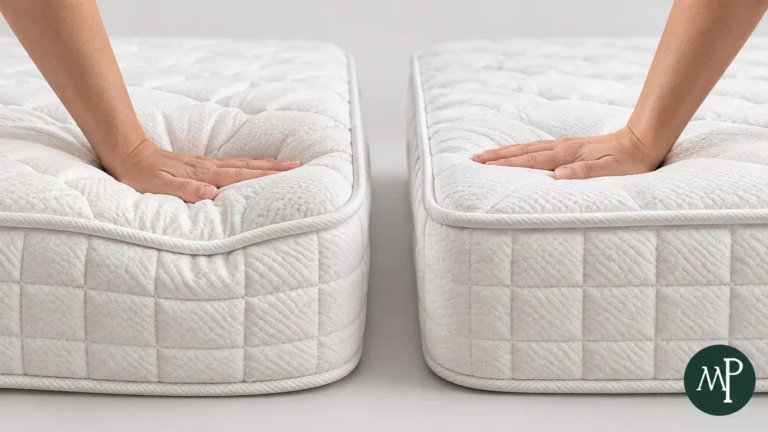
A mattress usually lasts 7 to 10 years if you bought it off a showroom floor, and the construction matters more than the brand name. What wears out first is almost never the fabric you can see: it is the support layer underneath. The day that layer holds the shape of your body instead of springing back, the mattress is done, even if it still looks clean.
We build mattresses in Montreal and we see both extremes: six-year-old mattresses that need replacing and fifteen-year-old mattresses that are still fine. The difference is rarely luck. Here is how to assess yours, what actually wears it out, and how to tell whether you should replace it now or in two years.
The short version
- A store-bought mattress lasts 7 to 10 years. Ours are built to last 20.
- The sign that settles it: a permanent dip of roughly 4 cm still visible in the morning on a stripped mattress.
- Waking up stiff but sleeping better elsewhere? The support is gone, not the comfort.
- Foam density and coil type decide longevity far more than price does.
- Rotating every six months, a protector, and a proper base: three habits that add years.
- Sagging cannot be repaired. A dirty surface can.
The most reliable test takes two minutes: strip all the bedding, look across the mattress at eye level, then lie down and have someone check whether your spine stays level.
How long a mattress lasts by construction
Useful life depends on whichever material carries your weight, which is why the honest answer to how long a foam mattress lasts is different from the answer for coils or latex. Here is what gives out first in each construction.
| Construction | What gives out first | What makes the difference |
|---|---|---|
| Foam | The support layer compacts and keeps the body impression | Density. High-density foam outlasts an entry-level foam of the very same thickness by a wide margin |
| Pocketed coils | Coils under the heaviest zones lose tension before the rest | Coil count, wire gauge, and whether the comfort layers above them hold up |
| Continuous coil | The unit softens more evenly, without a sharp localised hollow | Wire quality and how much padding protects the coil unit |
| Natural latex | Of the four, this is the material that holds its shape longest | All-latex ages better than a single latex layer sitting on ordinary foam |
| Hybrid | Almost always the comfort foam, before the coils | The quality of the comfort layer, because that is what caps the life of the whole build |

Remember the principle: in a multi-layer mattress, the weakest layer sets the lifespan of the entire mattress. An excellent coil unit under cheap foam will feel like a tired mattress long before anything is wrong with the coils. If those two constructions are exactly what you are weighing up, our guide on foam versus spring mattresses compares them point by point.
We work with high-density foam, gel foam, pocketed coils, continuous coil and Talalay natural latex, with organic cotton and natural wool in the finishing layers. Each family has its own page: foam mattresses for contour, spring mattresses for airflow, latex mattresses for how they hold up over time, and hybrid mattresses when the two approaches have to be combined.
Six signs it is time to replace your mattress
1. An impression that no longer disappears
Pull off the sheets and look across the surface at eye level, with light raking along it. A hollow still visible hours after you got up is sagging, not a wrinkled sheet. This is the most reliable sign of all, and the only one that cannot be fixed.
2. You sleep better somewhere else
If you wake up more rested after three nights in a hotel or at a relative’s house, your mattress is the reason. It is a test nobody enjoys accepting, but it is hard to argue with.
3. You can feel the structure through the layers
Feeling coils or a hard edge under your palm means the padding that used to cover them is compressed. On a spring mattress this often happens before any visible sagging.
4. The mattress shifts and creaks
A metallic noise when you change position, or a sense of rolling toward the middle, means the unit or the perimeter has lost its hold. Check the base first: a sagging foundation produces exactly the same symptoms as a finished mattress.
5. The edges no longer hold you
Sit on the edge of the mattress, at the spot where you sit every day to get dressed. If you slide toward the floor or the edge collapses completely, the perimeter reinforcement has gone. That zone wears quickly because it takes your whole weight on a small area.
6. Two sleepers, two hollows, and a roll to the centre
When a couple ends up in the middle of the bed every night, both sleeping zones have dipped and the centre strip has stayed high. No amount of rotating undoes that once it has set in.
One sign on its own might be something else. Two or more at the same time, and you no longer really have a question.

What wears a mattress out faster than expected
- An inadequate base. Slats spaced too far apart let foam flex between them. Plenty of mattresses judged defective are simply sleeping on a base that does not support them.
- Moisture. It damages foam and coil units in ways that do not reverse. It is also why an over-wet cleaning does more harm than good.
- Never rotating. Sleeping in the same spot for years concentrates all the wear on two zones.
- Weight and build. More load on the same area means faster compression. That is not a flaw, it is a factor to account for when choosing density.
- Always sitting on the same edge. The most heavily used part of a mattress is often the part nobody sleeps on.
- Moving house. Folding or compressing a mattress that was not designed for it can damage the structure permanently.
How to extend the life of your mattress
These habits will not save an already sagging mattress, but on one that is still sound they make a real difference.
- Rotate it every six months. Turn it head to foot. If it is reversible, flip it as well. Write the date on a sewn-in tag or in your phone, because nobody remembers otherwise.
- Use a mattress protector. It stops perspiration and spills before they reach the foam. It is the best value protection that exists for a mattress.
- Check the base once a year. Slats intact, spacing reasonable, centre leg present on larger sizes. A base that flexes cancels out everything else.
- Air out the room. Open the bed up for a while in the morning instead of sealing the night’s moisture in straight away.
- Vacuum the surface now and then. The full method is in our guide on how to clean a mattress, step by step.
- Do not always sit in the same place. Alternate the side of the bed you sit on to put your shoes on.
Repair, or replace?
The distinction is simple and worth being clear about.
What can be fixed: a stained or smelly surface, a creak coming from the frame rather than the mattress, a feel that is too firm or too soft and can be adjusted with a topper, a base whose slats need replacing.
What cannot be fixed: a sagging support layer, coils that have lost their tension, compacted foam, a collapsed edge. A topper laid over a hollow follows the hollow. It changes the surface feel and hides the problem for a few months without solving anything.
If your mattress is still sound but the firmness does not suit you, the issue is not lifespan: it is the wrong firmness choice at the outset. That gets solved differently, and often without replacing everything.
Our position on lifespan
A standard mattress lasts 7 to 10 years. We design ours to last 20, and that comes from specific manufacturing choices: higher foam densities, more serious coil units, and comfort layers that do not compact after three winters.
Customisation matters too, for a reason that is not obvious. A mattress matched to your weight, your sleeping position and, in a couple, to each side of the bed, wears more slowly than a standard mattress that is too soft or too firm for you. Foam pushed constantly beyond what it was specified for gives out sooner. We configure every mattress to the size, firmness and materials requested, and the consultation is included. It all starts with our custom mattresspage, where you can see what gets configured.
If you have concluded that yours has reached the end, the next step is choosing the next one properly. Our guide on how to choose a mattress works through sleeping position, weight, firmness, construction and budget, in that order.
Frequently asked questions
How long does a memory foam mattress last?
Density decides it, not thickness. Memory foam is a polyurethane foam like any other, so a dense one keeps its support for years while an entry-level one of the exact same thickness compacts far sooner. The same rule governs the high-density and gel foams we build with: gel manages heat, it does not change how the foam resists compression.
Should a mattress be replaced at eight years even if it is still good?
No. Eight years is an average, not an expiry date. Judge by the surface and by how you sleep, not by the calendar. A well-built mattress, properly supported and rotated regularly, can go well past that average.
Can sagging be corrected with a board under the mattress?
No. A board changes what is underneath, not the compressed layer inside the mattress. You will get a firmer feel and the hollow will still be there.
How long does a latex mattress last compared with foam?
Of our four constructions, natural latex is the one that holds its shape longest. All-latex ages better than a latex layer over an ordinary foam base, because in the second case it is the foam underneath that sets the lifespan.
Does rotating really change anything?
Yes, if you start early. Rotating spreads the wear instead of concentrating it on two sleeping zones. Started on a mattress that has already dipped, it recovers nothing.
My mattress is eight years old and has not sagged. What should I check?
The base and the edges. A tired foundation imitates a finished mattress perfectly, and a collapsed edge gets in the way of daily use long before the centre moves. If both are sound and you sleep well, keep it.