Mattresses and Back Pain: What Support Actually Changes

Let us say this at the outset, because almost nobody in our industry does: a mattress does not cure back pain. There is no evidence allowing anyone to claim that a model treats, prevents or heals lower-back pain, and a manufacturer who promises you that has gone past what the research supports. What a mattress can do is more modest and entirely real: it decides the position your spine spends seven or eight hours a night in.
This page sets out what the research actually establishes, what it does not, and how to choose support on that basis. If you have persistent pain, the first step is a health professional, not a mattress shop.
The short version
- The available evidence points toward medium firmness rather than a very firm mattress.
- The reflex of buying the hardest thing available to protect your back is not supported by the studies.
- What matters is alignment: the pelvis should neither drop below the shoulders nor hang unsupported.
- A sagging base produces the same effects as a bad mattress, and costs far less to fix.
- Pain that persists, wakes you at night or travels down the leg is a matter for a health professional.
What the landmark trial found
The study most often cited on this subject is a randomised, double-blind trial published in The Lancet in 2003 by Kovacs and colleagues. The researchers followed 313 adults with chronic non-specific low back pain, meaning lower-back pain with no identified structural cause, who reported hurting in bed and on getting up. Participants were randomly assigned either a firm mattress or a medium-firm one, then reassessed after 90 days.
The result: after 90 days, the medium-firm group did better than the firm group for pain in bed and for disability. The authors concluded that a mattress of medium firmness improves pain and disability in people with chronic non-specific low back pain.
Three honest caveats, because commercial comparisons almost always leave them out. First, the advantage for pain on rising did not reach statistical significance: the effect pointed the same way, but the confidence interval included no difference at all. Second, the study compares two firmness levels against each other, not one brand against another, and says nothing about which model to buy. Third, it dates from 2003 and covers a specific population: adults with chronic non-specific pain, not healthy people and not cases with a known structural cause.
What you can reasonably take from it: if your back hurts, very firm is not the default choice, and medium deserves at least to be tried before it.
Why too firm causes trouble
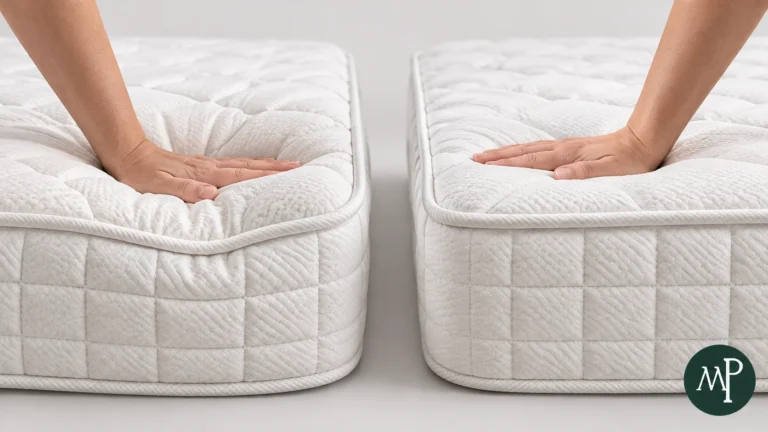
A surface that gives way nowhere carries your body only on its most prominent points. On your back, that means the shoulder blades and the pelvis, with the hollow of the lower back touching nothing at all. On your side, it means the shoulder and the hip, with the waist left hanging. Either way, part of your back spends the night holding a position the mattress should be holding for it, and the contact points take concentrated pressure.
Why too soft causes the opposite problem
The pelvis is the heaviest part of the body. On a surface that gives way without holding anything back, it sinks lower than the shoulders and the knees, and the spine takes on a curve it does not have standing up. This is the hammock shape, and it is why an old hollowed-out mattress often hurts more than one that is merely hard.
Check the base before blaming the mattress
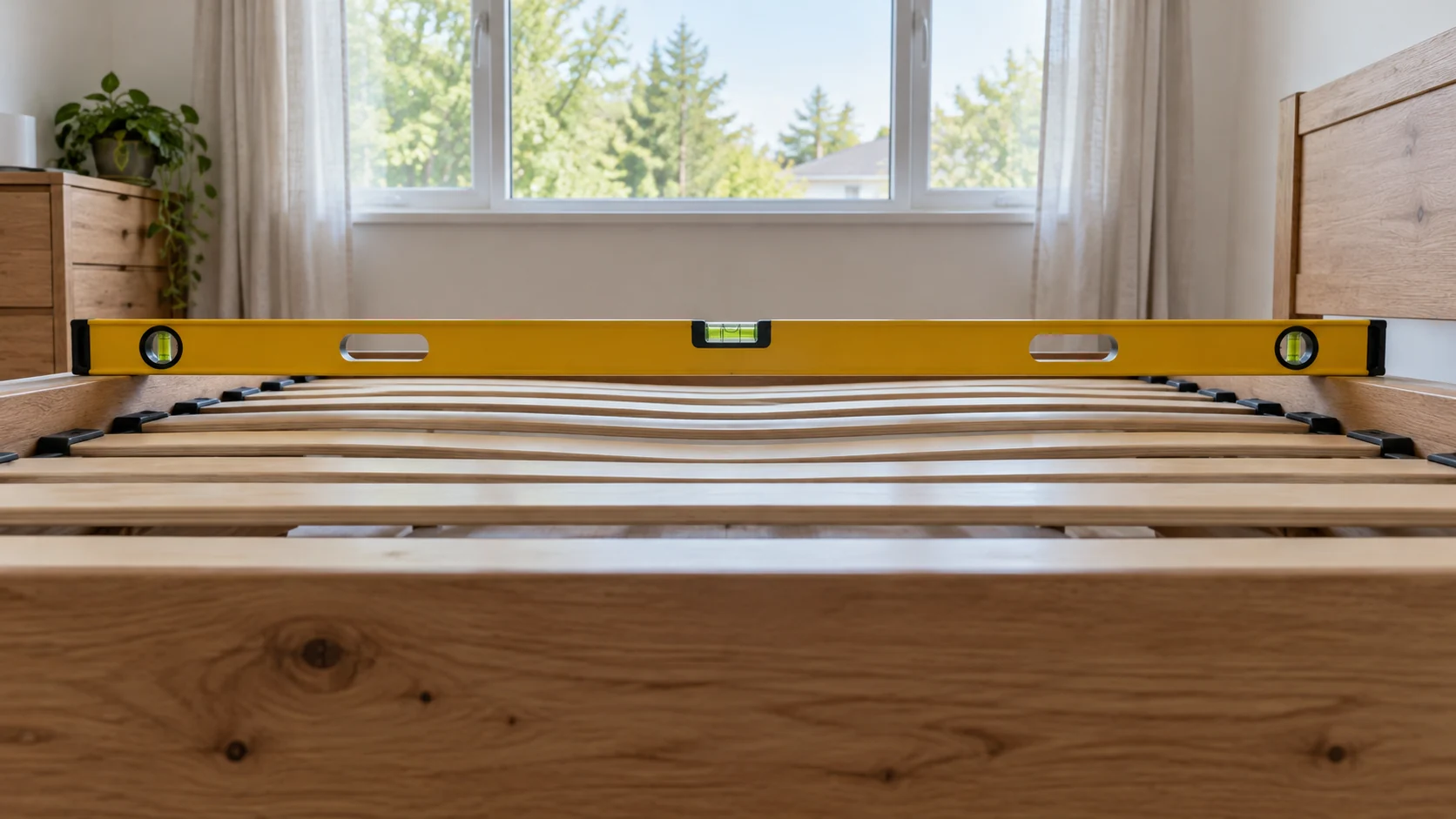
This is the mistake that costs the most for no reason. A sagging base, a tired box spring, or slats spaced more than roughly 7 cm apart let the mattress deform between the supports, and the sensation is exactly that of a mattress which is too soft. People then replace a perfectly good mattress, put the new one on the same base, and find the problem back within months.
The test takes two minutes: take the mattress off, lay a long straight edge or a level across the base, and look underneath it. If light passes through in the middle, the base needs replacing before you spend money on anything else.
Choosing support for your position
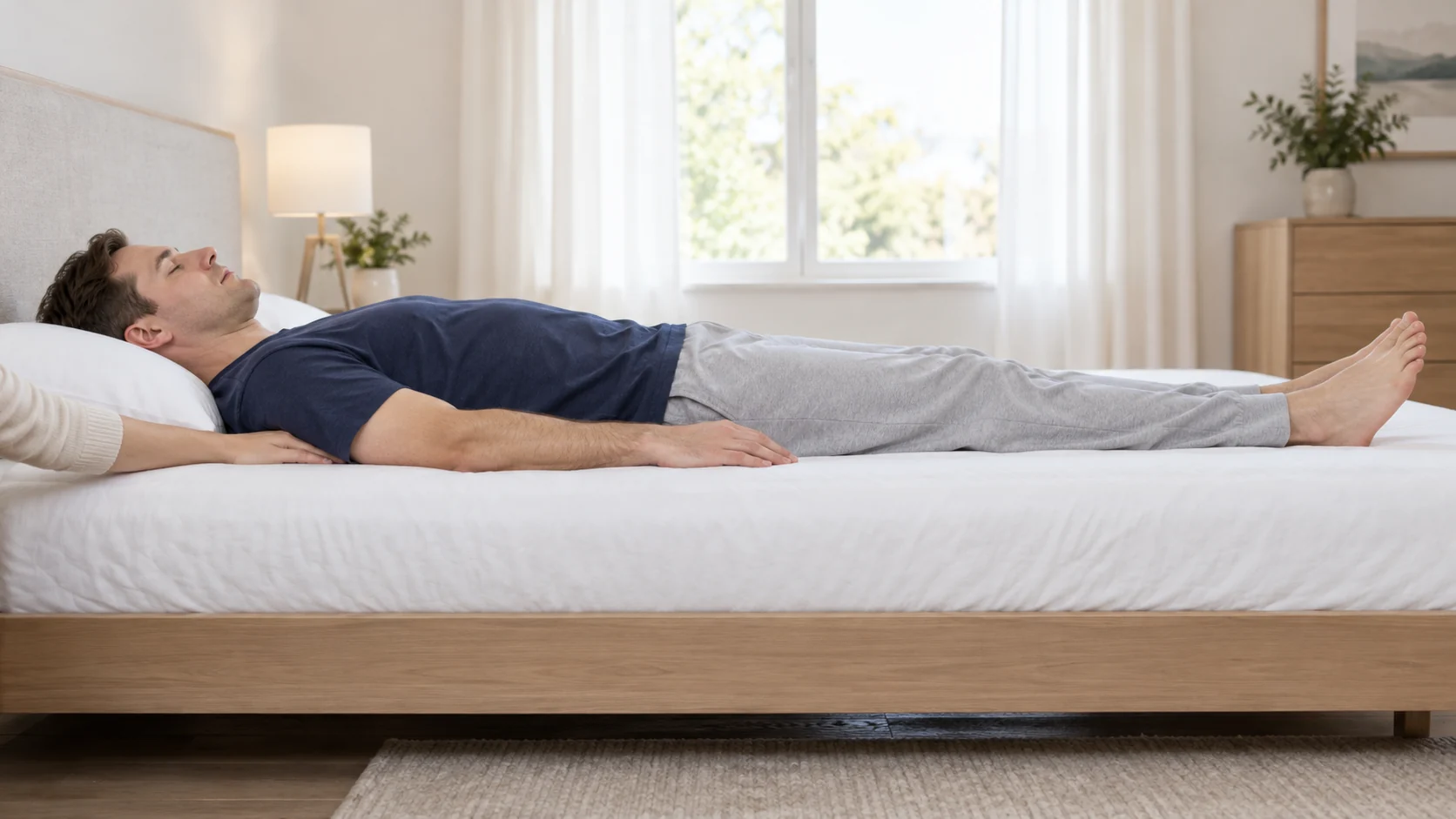
Once the base is ruled out, the logic is the same as for any sleeper, with a little extra caution: aim for alignment, and when you are hesitating between two steps, try the softer one before the firmer one.
| Usual position | What should sink in | What should be held up |
|---|---|---|
| Side sleeping | The shoulder and the hip | The waist, which must not be left hanging |
| Back sleeping | The upper back, slightly | The pelvis, and the lumbar hollow must stay filled |
| Stomach sleeping | Almost nothing | The pelvis, which must not drop below the shoulders |
The detail of how your weight crosses with your position is in our guide on choosing between a firm and a soft mattress, which has the full table.
What a mattress will not fix
The limits need stating plainly. Pain that travels into the buttock or the leg, pain that wakes you reliably at night, pain accompanied by numbness, weakness, fever or unexplained weight loss are not bedding problems. They call for medical advice, and replacing a mattress in those cases amounts to delaying the right step.
In the same way, a mattress does not compensate for a working posture, a lack of activity or an untreated injury. It removes one variable, which is useful, but only one.
If you are not sure what to do next, the Government of Quebec’s Info-Santé 811 service answers free of charge, around the clock: Info-Santé 811.
Where we stand
We build mattresses in Saint-Leonard and we sell no model as an orthopaedic or therapeutic mattress, because we cannot support that kind of claim. What we do is build every model in three firmness levels with the same support layer, so that you can aim for the alignment that suits you without changing range or paying more.
If you are already seeing a professional, come to us with whatever they recommended in terms of support, and we will work from there. You can reach us at 514-725-1000, or start with our guide on how to choose a mattress.
Frequently asked questions
Which firmness should I choose if my back hurts?
The available evidence points toward medium firmness rather than a very firm mattress. That remains a starting point to adjust for your weight and your position: a larger person who sleeps on their stomach needs more support than a light person who sleeps on their side, even with the same pain.
Does a board under the mattress help?
It is a stopgap, not a solution. A board does stop a mattress sinking between slats that are too far apart, and it can bring relief for a few weeks. But it removes all give from the base and it does not fix a worn support layer. If a board makes a difference for you, the real diagnosis is that the base needs replacing.
Is memory foam recommended for your back?
It is neither recommended nor advised against in itself. Memory foam spreads pressure well, which suits many side sleepers, but it holds heat and, at low density, it hollows out over time, which eventually produces the very sagging you were trying to avoid. Density decides the outcome, not the technology.
How long before I know whether a mattress suits me?
Two to four weeks. A back used to a dip takes a while to readjust, and it is common for the first few days to feel worse than the old mattress did. Beyond a month with no improvement, it is no longer an adjustment question.
Can a mattress cause back pain?
It can sustain or worsen discomfort by holding your spine out of alignment for hours at a time, particularly once it has sagged. Attributing the origin of pain to a mattress is a different matter, and that is a question to settle with a professional rather than with a salesperson.
Should I change mattress if the pain started recently?
Not first. Check the base, then the age and condition of the mattress: if the imprint of your body no longer disappears in the morning, the support layer has given out and replacement is justified. Our six end-of-life signs are set out in our guide to how long a mattress lasts.
Source
Kovacs FM, Abraira V, Peña A, et al. Effect of firmness of mattress on chronic non-specific low-back pain: randomised, double-blind, controlled, multicentre trial. The Lancet, 15 November 2003, volume 362, issue 9396, pages 1599 to 1604.
Full reference for the trial cited above, available on PubMed. For choosing the firmness itself, see our guide on firm or soft mattresses.