Which Mattress for a Murphy Bed? Thickness, Weight and Materials

For a Murphy bed, choose a mattress whose total thickness stays within the bed maker’s limit, that is not too heavy for the mechanism and that keeps its shape when the bed is raised upright. In most cases, a one-sided foam or latex mattress of about 8 to 10 inches is the simplest choice. Our XtraRoom wall beds take standard mattresses up to 12 inches thick.
A Murphy bed is not like other beds. The mattress spends its days standing upright against a wall, then folds down every evening. This guide explains what really matters in that setting, and how to check that a mattress fits before you buy it.
The four criteria that matter
Comfort still matters, but a Murphy bed adds constraints that a fixed bed does not have. Check these four points, in this order.
- Thickness. The mattress has to fit inside the cabinet once the bed is closed. This is the strictest limit, and it is set by the bed maker.
- Weight. The mechanism is set to lift the frame with a mattress on it. A mattress that is much heavier or much lighter than expected changes the effort needed to open and close the bed.
- Holding its shape upright. The mattress must stay straight and in place when it is raised, day after day, without sliding or sagging.
- Size. The mattress must match the bed’s size exactly, Queen or Double, without overhanging the frame.
Thickness: the limit you cannot exceed
Every Murphy bed states a maximum mattress thickness. For the XtraRoom models we sell, it is 12 inches. Beyond that, the bed closes poorly, or not at all, and the mattress is pressed against the cabinet every time it closes.
Two details often make the difference:
- Thickness is measured including the cover. The quilting on top adds thickness to the inner layers. A mattress described as having 10 inches of foam can measure more once it is covered.
- Bedding counts too. A thick duvet, a mattress topper and pillows all take up space. On our Azores models, the maker asks that the bedding be removed before closing. Leave a margin under the limit if you want to keep the sheets on.
A thick mattress topper is therefore rarely a good idea on a Murphy bed. If you want a softer feel, it is better to build it into the mattress itself by choosing a softer comfort layer.
Weight and the mechanism
Our XtraRoom beds lift on hydraulic pistons. Like every mechanism of this type, they are designed to balance the weight of the frame and a mattress. If the mattress is very heavy, the bed becomes harder to raise and comes down faster. If it is very light, the bed can tend to rise on its own.
The material has a direct effect on weight. At the same thickness, latex is heavier than foam, and a pocket coil mattress with several comfort layers weighs more as well. That is not a reason to rule out latex: it is a reason to check the weight with us before buying, along with the thickness.
The 800-pound capacity listed for our XtraRoom beds applies to the open bed, with the sleepers on it. It does not tell you which mattress weight the mechanism balances best.
Which material to choose?
Every material can work as long as the thickness and weight stay within the bed’s limits. They do not all behave the same way when upright.
| Material | Upright | Weight | Best for |
|---|---|---|---|
| High-density foam | Keeps its shape well | Lightest | Guest room, regular use |
| Natural latex | Keeps its shape well | Heavier than foam | Nightly use, hot sleepers |
| Latex over a foam base | Keeps its shape well | In between | Latex feel at a more reasonable weight |
| pocket coils | Possible, check it | Heaviest | Only if the total thickness allows it |
Foam and latex form a uniform block that stays straight when raised. That is why they are recommended most often for a Murphy bed. Spring mattresses work too, but they are thicker: in the one-sided version, our pocket coil models measure 11 to 12 inches, which leaves almost no room for bedding.
Finally, avoid folding mattresses or mattresses made in several pieces. Their hinge leaves a mark over time, and the sections can shift when the bed is raised.
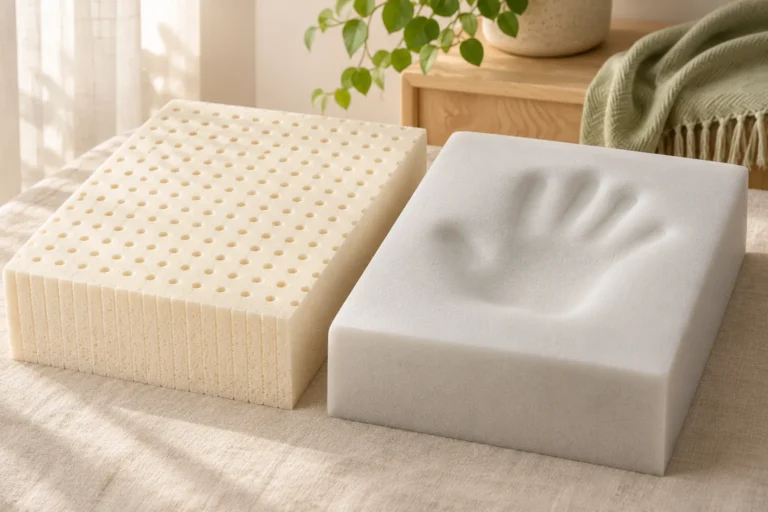
To compare how the two materials feel, see our guide on latex vs memory foam.
One-sided or two-sided?
Our foam and latex mattresses are made one-sided, with the comfort layers on top. The Neptune is the exception: it is a uniform foam block that can be flipped.
Our pocket coil mattresses also come in a two-sided version, but it measures 14 to 16 inches: it exceeds the 12-inch limit of our Murphy beds.
Our mattresses that suit it best
All of our foam and latex mattresses fit under the 12-inch limit, with room left for bedding. Here is their total thickness, cover included. We confirm the weight of the size you want before you order.
| Model | Construction | Total thickness |
|---|---|---|
| Lucern Plus | Talalay latex on an extra-dense foam base | 7.5 in. |
| Volupte | Two foam layers on a high-density foam base | 8.5 in. |
| Naples | Two foam layers on an extra-dense foam base | 8.5 in. |
| L’ultime | Four inches of Talalay latex on a high-density foam base | 8.5 in. |
| Neptune | High-density foam block, reversible | 9 in. |
| Talalay 8 inch | Natural Talalay latex, no foam core | 9 in. |
| Imperial | Gel, latex and foam on an extra-dense foam base | 9.5 in. |
For a guest room, the Neptune is the simplest choice: firm, reversible and with no layers to choose. The Volupte gives a more welcoming surface for nightly use. The Lucern Plus is the thinnest in the collection and gives the feel of latex on top with a foam base, so it weighs less than an all-latex mattress. The Talalay 8 inch suits people who want all latex, as long as its weight is checked with us.
For firmness, the same rules apply as for any bed. Our guide to firm or soft mattresses helps you choose based on how you sleep.
Before you buy: the checklist
- The exact Murphy bed model, and the maximum thickness stated by its maker.
- The bed size: Queen (60 × 80 in.) or Double (54 × 75 in.). Our mattress size guide lists every size.
- The ceiling height: our XtraRoom models need at least 8 feet.
- The bedding you want to leave in place when the bed is closed.
- The intended use: a few guest nights a year, or every night.
For a Murphy bed already installed in your home, from another brand or in an unusual size, we can also make a custom mattress, thinner if needed. The principle is the same as for RV beds, explained in our guide to custom RV and boat mattresses.
Frequently asked questions
Can you put a regular mattress on a Murphy bed?
Yes, as long as its total thickness and weight stay within the bed’s limits. Our XtraRoom beds take standard mattresses up to 12 inches thick. A Murphy bed mattress does not need to be a special product: above all, it has to fit in the cabinet and stay in place.
What mattress thickness for a Murphy bed?
The one stated by the bed maker, cover included. For our XtraRoom models, it is 12 inches at most. A mattress of about 8 to 10 inches leaves a comfortable margin for the bedding.
Will the mattress sag from standing upright?
A good-density foam or latex mattress keeps its shape upright, because it forms a uniform block. What damages it instead is being pressed against the cabinet because it is too thick. Hence the importance of respecting the limit.
Is a Murphy bed fine for sleeping every night?
Yes. The bed itself rests on a steel frame with European slats, like a fixed bed. If you sleep on it every night, choose the mattress as you would for your main bedroom, with the support and firmness that suit you, within the bed’s thickness limits.
Come and see them together
The simplest approach is to choose the bed and the mattress at the same time. Browse our XtraRoom wall beds, then write to us or call us at 514 725-1000: we check the mattress thickness and weight with you before you order. You can also try our foam and latex mattresses in our stores.