Talalay vs Dunlop Latex: What’s the Difference for Your Mattress?
Talalay latex and Dunlop latex start from the same material: the sap of the rubber tree, or a blend of that sap and synthetic latex. What separates them is how they are made. Dunlop is foamed, poured into a mould and baked, which gives a dense, firm block. Talalay goes through two extra steps, vacuum sealing and freezing, which give a foam that is airier, more uniform and softer, but more expensive to produce. Neither is better in itself: the right choice depends on the feel you are looking for.
We have been building mattresses in Saint-Léonard since 1980, and our latex models use Talalay latex. Further down we explain why, and when Dunlop might suit you better.
Key takeaways
- Same raw material, different manufacturing: it is the process that changes the feel.
- Talalay is softer, more uniform and usually more expensive. Dunlop is denser, firmer and usually less expensive.
- No independent study clearly settles which one lasts longer. Density, thickness and the written warranty tell you more.
- “Talalay” and “Dunlop” do not guarantee natural latex: both processes can use natural latex, synthetic latex or a blend.
- The surest way to decide is to try them lying down.
How each latex is made
Both processes start the same way: liquid latex is mixed with a few additives, then whipped into a foam to trap air inside it. That is where the paths split.
The Dunlop process
It is the oldest and the simplest. The first latex foam was made in 1929 by two chemists at the Dunlop Rubber company, from whipped latex. The foam is poured into a mould, then baked to set it, a step called vulcanisation.
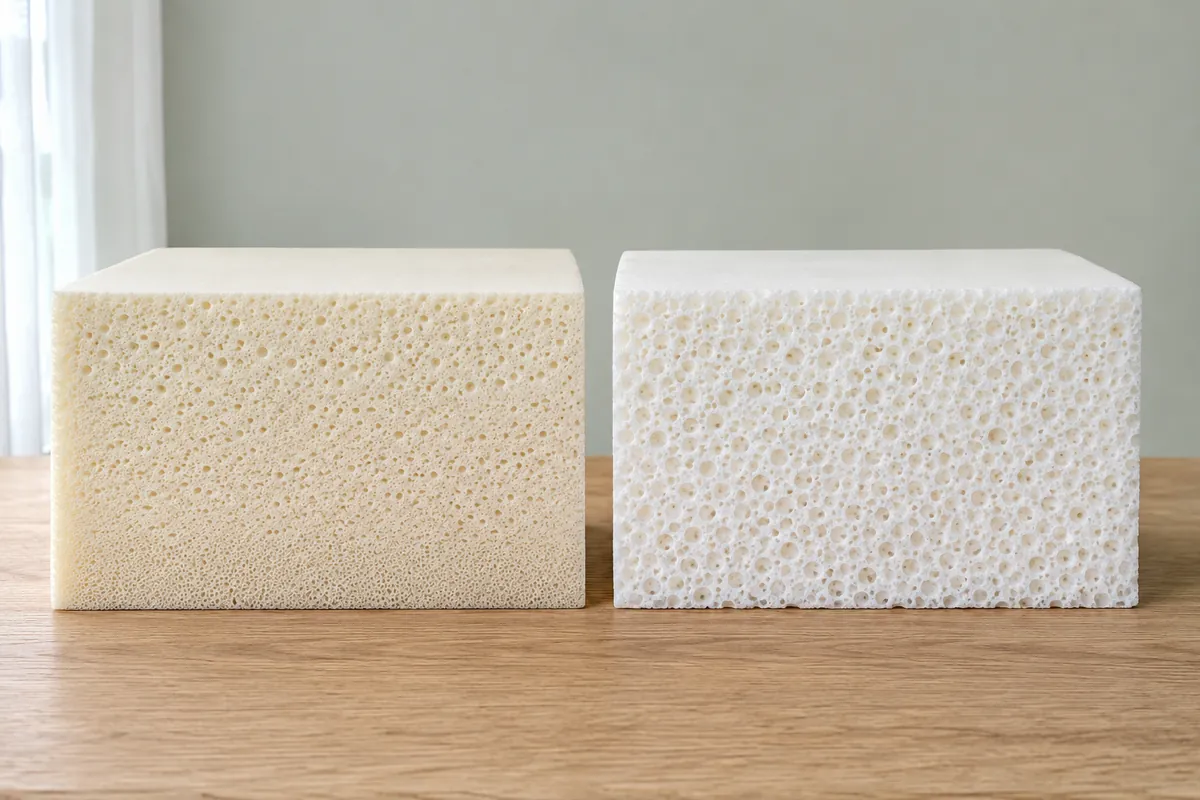
Because nothing sets the foam before baking, the heavier particles have time to settle. Several industry sources therefore describe a block that is slightly denser at the bottom than at the top. Dunlop also has a fuller, firmer feel.
The Talalay process
Developed by the Talalay brothers and made commercially viable in the late 1940s, this process adds several steps. Talalay Global, the main producer of this latex, describes them as follows:
- The mould is only partly filled, then closed.
- Air is pumped out: the foam expands and fills the whole space evenly.
- The mould is frozen at about -30 °C (-22 °F). According to Talalay Global, this step is precisely what stops the particles from settling.
- The foam is heated to set it into a gel, washed in five stages, then vulcanised.
The result is a foam with more regular cells and the same density from top to bottom. Those steps take more equipment, more energy and more time, which is why Talalay usually costs more.
What you feel lying down
On a spec sheet, the difference comes down to a few words. Lying down, you feel it straight away.
- The surface. Talalay follows the body more softly and more evenly. Dunlop feels denser, with firmer push-back under the shoulders and hips.
- The bounce. Both spring back quickly, which is what sets latex apart from memory foam. Talalay is often described as springier, Dunlop as more stable.
- Heat. According to its makers, Talalay’s airier structure lets a little more air through. The cover and your bedding matter too.
- Firmness. Both come in several firmness levels, and a firm Talalay can come close to a soft Dunlop. Compare the actual firmness, not just the name of the process.
The comparison table
| Criterion | Talalay | Dunlop |
|---|---|---|
| Process | Partly filled mould, vacuum, freezing, baking | Foam poured into a mould, then baked |
| Density | The same from top to bottom | Often slightly denser at the bottom |
| Feel | Softer, springier | Denser, firmer |
| Common use | Comfort layers, or all-latex mattresses | Support core, or all-latex mattresses |
| Price | Usually higher | Usually lower |
| Material | Natural, synthetic or a blend | Natural, synthetic or a blend |
Which one lasts longer?
It is the question we are asked most often. The honest answer: we have not found any independent study comparing the lifespan of the two processes at the same density. Many websites claim Dunlop lasts longer because it is denser, and some even give a precise number of years, without saying where it comes from.
What really wears a latex mattress out is first the density and thickness of the latex, then the cover, the base it sits on and how it is cared for. Eight inches of dense Talalay does not age like a thin layer of Dunlop on top of foam, and the reverse is just as true.
The best written indication is still the warranty. Look at how long it runs, but above all at how many years give a full replacement, with no sliding scale. Our Talalay 8-inch is covered for 25 years, with no sliding scale: see our warranty and our article on how long a mattress lasts.
Natural, synthetic or blended: reading the label
Talalay and Dunlop are manufacturing processes, not materials. Both can be made from fully natural latex, tapped from the rubber tree, from synthetic latex (SBR, a petrochemical rubber), or from a blend of the two. A mattress sold as “Talalay latex” is therefore not necessarily natural.
Three questions to ask before you buy:
- What share of the latex in the mattress is natural?
- Is the latex certified, and by whom?
- Is latex the only material, or does it sit on foam or springs?
The certifications that matter
- OEKO-TEX® Standard 100 checks that the finished product contains no harmful substances above limits set for its intended use. It says nothing about whether the material is natural or organic.
- eco-INSTITUT is a German laboratory that tests mattresses for emissions and pollutants, such as volatile organic compounds, heavy metals and pesticides. The QUL label for latex mattresses, for which it carries out the testing, also requires fully natural latex.
- GOLS certifies organic latex and tracks the material from the harvest onward. It is the seal to look for if organic farming matters to you.
- CertiPUR-US® covers polyurethane foam only. It says nothing about latex: on a mattress that combines the two, it covers only the foam.
The Talalay latex we use is natural latex, certified by OEKO-TEX® and eco-INSTITUT. Our Talalay 8-inch contains eight inches of it, with no foam core.
Which one suits the way you sleep
There is no medical rule here, only comfort preferences. Here are a few pointers.
- You sleep on your side and like the mattress to follow your shoulder and hip: Talalay, softer at the surface, is often the most comfortable.
- You sleep on your back or your front and prefer a surface that gives very little: a Dunlop, or a Talalay in a firm firmness.
- You move a lot at night: both spring back quickly, an advantage latex has over memory foam.
- You share the bed and do not like the same firmness: with us, each side of the mattress can have a different firmness.
If you are unsure, our article on firm or soft mattresses helps you pin down your preference.
Also read: Latex vs Memory Foam Mattress: Which Should You Choose?
Combining the two
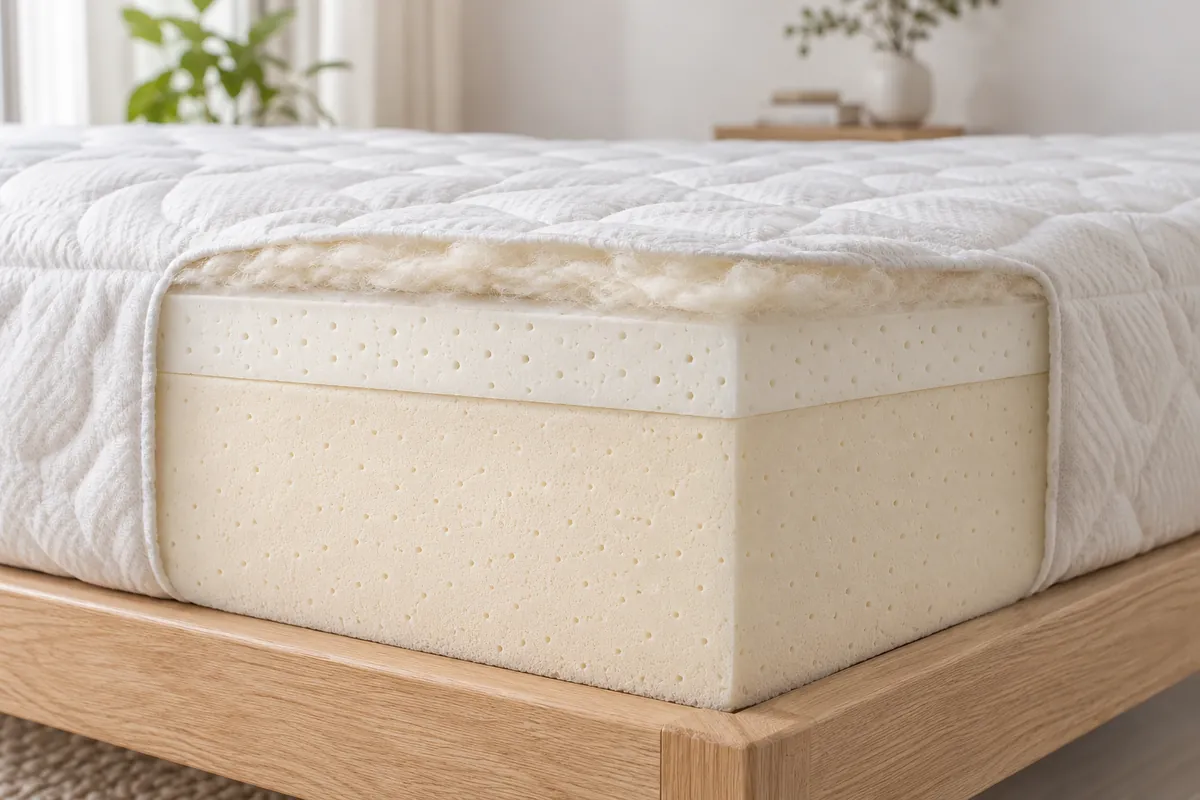
Many mattresses stack the two: a layer of Talalay on top for softness, over a Dunlop core for firmness. Others put the latex on foam or pocketed springs. Here is how our models that contain latex are built:
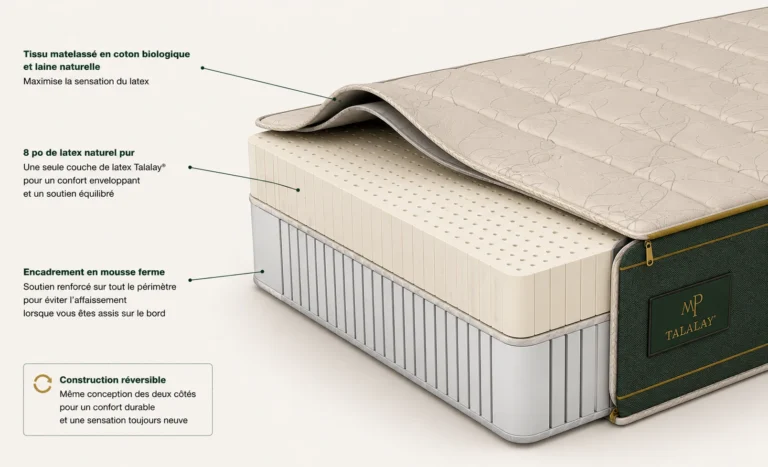
- Talalay 8-inch: eight inches of Talalay latex, with no foam core. The latex provides both comfort and support.
- L’ultime: four one-inch layers of Talalay, three of them exchangeable, on a three-inch base of high-density foam.
- Lucern Plus: two one-inch layers of Talalay on a high-density foam base.
- Le Suprême: two one-inch layers of Talalay on pocketed springs.
All of them have an organic cotton cover quilted with natural wool.
What Talalay brings to our mattresses
- An even feel. Because Talalay has the same density from top to bottom, the feel stays the same across the whole surface of the Talalay 8-inch, right up to the edges.
- Layers to order. Its softness lets us work in one-inch layers, put together to match the firmness you want.
- Layers that can be changed. On L’ultime, the comfort panel closes with a zipper. For the first 60 days, layers can be exchanged free of charge, then at the cost of the materials.
We do not offer an all-Dunlop model. If that is what you are after, ask the maker for the thickness of latex, its share of natural latex and its certifications, and compare the written warranty. Our comparison of the best latex mattresses in Canada covers a few of them.
Try before you buy
The best way to decide is still to lie down on both. At our Saint-Léonard showroom, at 4600 boulevard des Grandes-Prairies, you can compare our latex models.
You can also browse our latex mattress collection or write to us.
Frequently asked questions
Is Talalay latex better than Dunlop?
Neither is better in itself. Talalay is softer and more uniform, Dunlop denser and firmer. The right choice depends on the feel you prefer.
Which one lasts longer?
No independent study clearly settles it. Density, thickness, the base and care matter more than the process. Rely on the written warranty, and above all on the number of years with no sliding scale.
Is Talalay latex always natural?
No. Talalay can be made from natural latex, synthetic latex or a blend of the two. Ask for the composition and the certifications.
Which one sleeps cooler?
According to its makers, Talalay’s airier structure lets a little more air through. The cover and your bedding matter too.
Why does Talalay cost more?
Making it adds vacuum sealing, freezing and more production time, which takes more equipment and energy.
Can Talalay and Dunlop be combined?
Yes, it is common: a layer of Talalay on top of a Dunlop core. Our models instead combine Talalay with high-density foam or pocketed springs.