Mattress Stains: How to Remove Them by Type
The right way to remove a mattress stain depends entirely on what caused it, because the three main families of stain do not come out the same way. A protein stain like blood or sweat sets with heat and is treated with cold water. A greasy stain like body oil or makeup needs something that dissolves fat. A pigment stain like wine or coffee needs something that lifts colour. Using the wrong family of product does not just fail to shift the stain: more often than not, it makes it permanent.
We build mattresses and we see plenty that were ruined by the cleaning rather than by the stain. Here is how to identify what you are looking at, and what to do in each case.
The short version
- Cold water on anything that came from a body. Heat cooks proteins and sets the stain for good.
- Blot from the edge inward, never scrub: scrubbing widens the stain and drives the liquid deeper.
- Use as little water as you can. Moisture trapped in the foam is what creates lasting smells.
- Always test on a corner that does not show, especially with peroxide, which bleaches.
- A faint mark on a mattress that does not smell and still supports you is not a reason to replace it.
Identify the family before choosing the product
Before you open anything under the sink, put your stain in one of the three boxes below. This is the step almost everyone skips, and it is the one that decides the outcome.
| Family | Common examples | What works | What makes it permanent |
|---|---|---|---|
| Proteins | Blood, sweat, vomit, milk | Cold water, then enzymes if the stain is old | Hot water and steam |
| Body oils | Sebum, body lotion, makeup, hair oil | A drop of dish soap in lukewarm water | Baking soda alone, which absorbs without dissolving |
| Pigments | Wine, coffee, tea, ink | Diluted peroxide on pale fabric, tested first | Rubbing, which spreads the pigment around |
Yellow rings, the most common stain of all
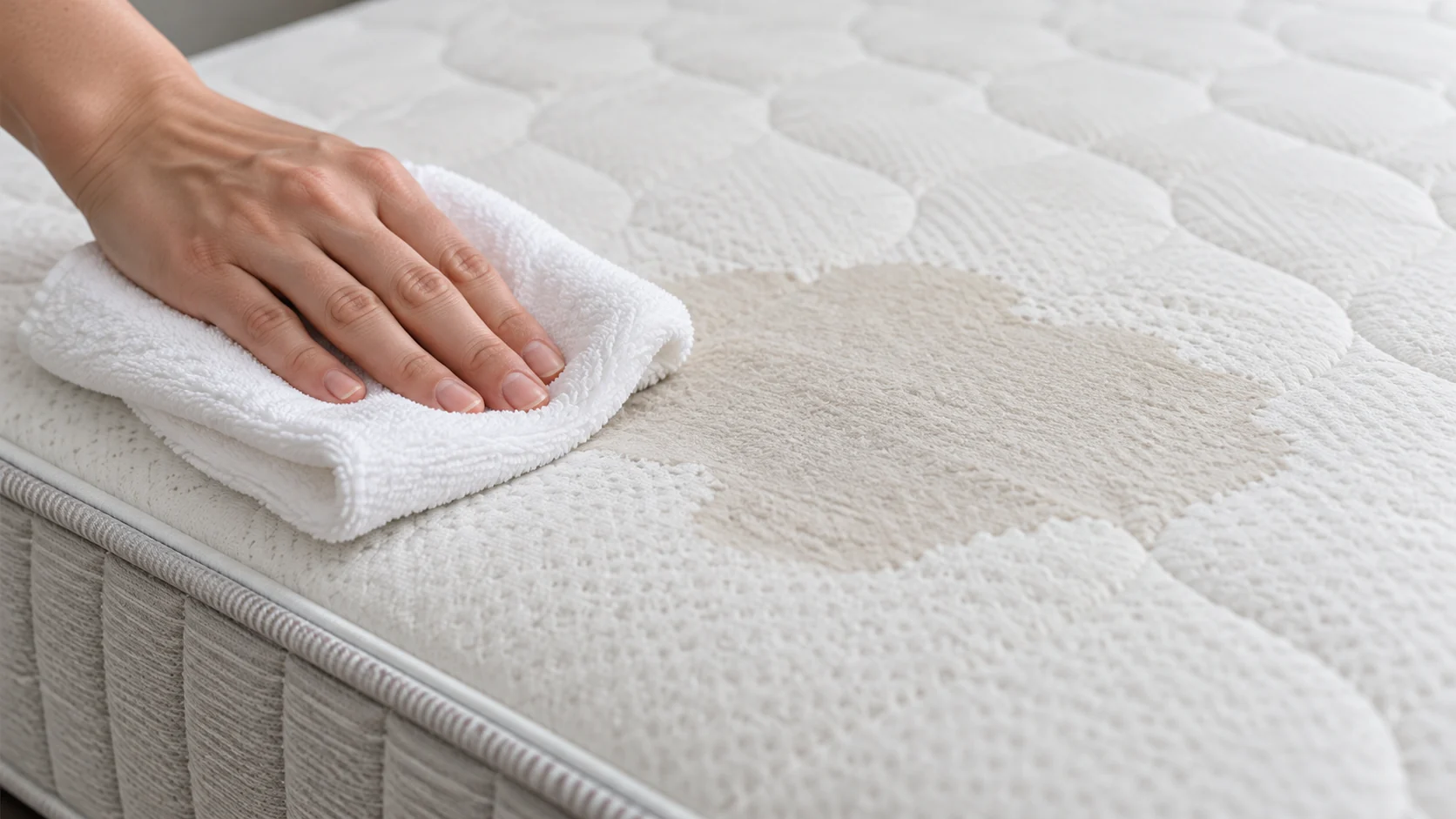
This is the stain we see most, and almost nobody identifies it correctly. The large diffuse yellow marks in the middle of a mattress are neither dirt nor mould: they are a mixture of sweat and body oil, built up over months, which oxidised as it dried. That means it belongs to two families at once, proteins and body oils, which is why baking soda alone never shifts it.
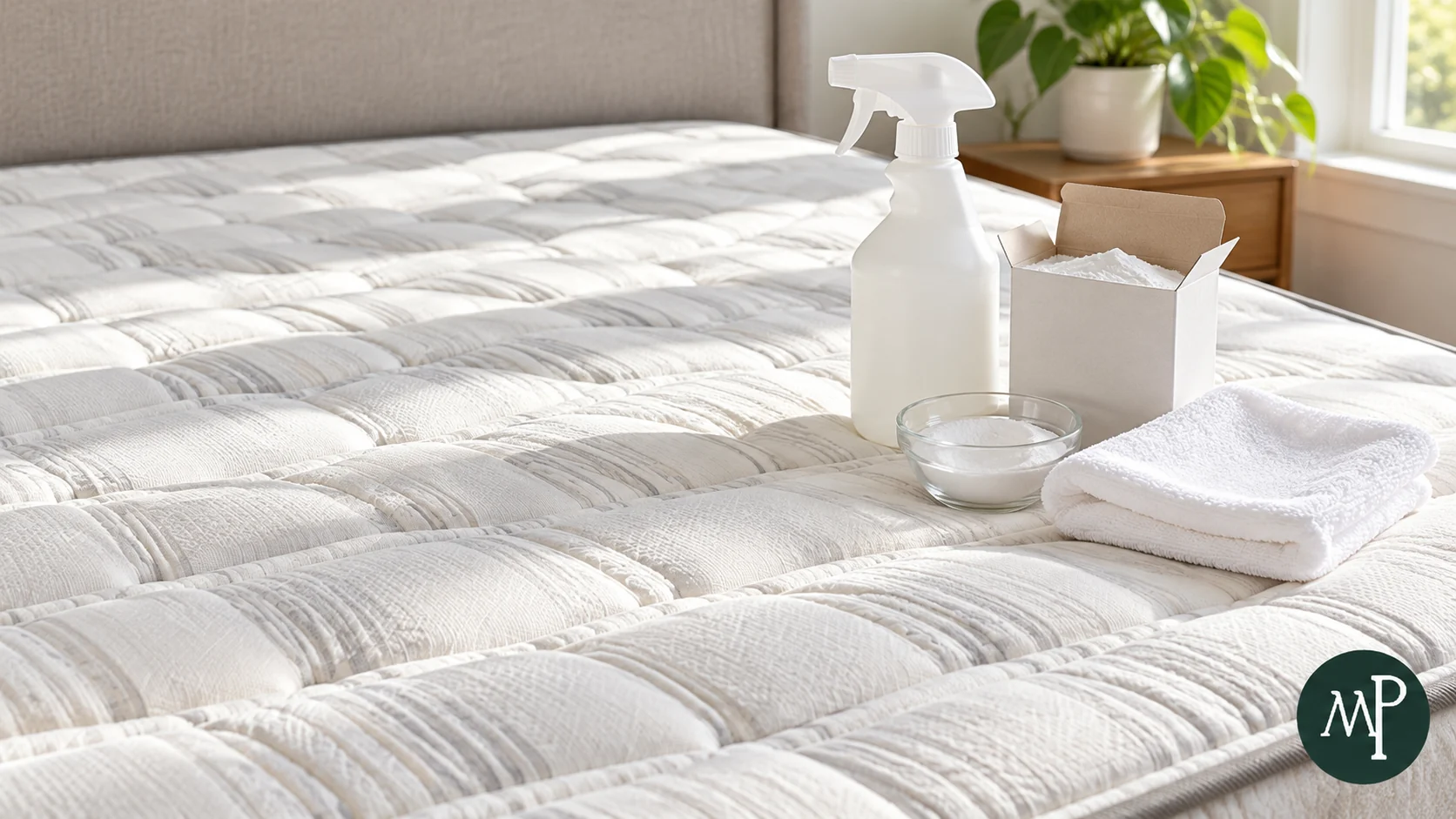
The sequence that works: start with lukewarm water and a single drop of dish soap, to attack the greasy part. Blot, leave it ten minutes or so, lift it with a barely damp cloth. If the colour remains, move on to the pigment with 3 percent hydrogen peroxide diluted by half, always after testing on a hidden corner. Finish with baking soda to absorb the remaining moisture, then vacuum.
Be realistic about the outcome: a ring that is several years old fades far more often than it vanishes. The reasonable goal is a clean mattress that does not smell, not a brand-new ticking.
Blood
The absolute rule is cold water, and it has no exceptions. Blood contains proteins that coagulate with heat: a single application of hot water, steam or hot air turns a recoverable stain into a permanent mark. On fresh blood, cold water and patient blotting are enough in the large majority of cases.
On dried blood, the most effective preparation remains three tablespoons of baking soda in a cup of 3 percent hydrogen peroxide, with one drop of dish soap. Apply it, let it air dry without rinsing, then vacuum up the powdery residue. Testing on a hidden corner first is not optional, and never use it on natural latex.
Vomit
Lift the solids first with a spatula or the edge of a piece of card, scraping toward the centre so you do not spread the area. Acidity is the real problem here: it attacks the ticking fibres if it stays in place. Neutralise with equal parts cold water and white vinegar, blot, then treat what remains as a protein stain. Baking soda at the end deals with the residual smell.
Wine, coffee and tea
These are pigments, and the instinct to scrub is exactly wrong: you spread the colour over a larger area. Blot up all the liquid that is still mobile first, then work from the edge inward. On pale ticking, diluted peroxide works well. On dark or patterned fabric, accept that the bleaching may end up more visible than the stain, and settle for a mild soap clean.
Greasy stains
Body lotion, hair oil, foundation: these do not come out with water, because water and grease do not mix. You need a surfactant, and the most accessible one is dish soap. A single drop in lukewarm water is enough; more leaves a soapy residue that then attracts dust and creates a fresh mark.
For a fresh greasy stain, sprinkle cornstarch on it first and let it absorb for about fifteen minutes before moving to the soap. That step removes the portion of the grease that has not yet soaked in, and it cuts down the work that follows considerably.
What you must never do
- Using hot water or a steam cleaner on anything that came from a body.
- Pouring water directly onto the mattress: it reaches the core and never comes back out.
- Using bleach, which strips the colour from the ticking and attacks foams and adhesives.
- Scrubbing with a brush, which opens the fibres and drives the stain in.
- Putting a sheet back over an area that is still damp, which sets up a musty smell.
- Mixing peroxide and vinegar together in the same container.
On mixing cleaning products, which is the most dangerous item on this list, the Canadian Centre for Occupational Health and Safety explains which combinations release toxic gases: CCOHS fact sheet on bleach.
Drying decides the outcome
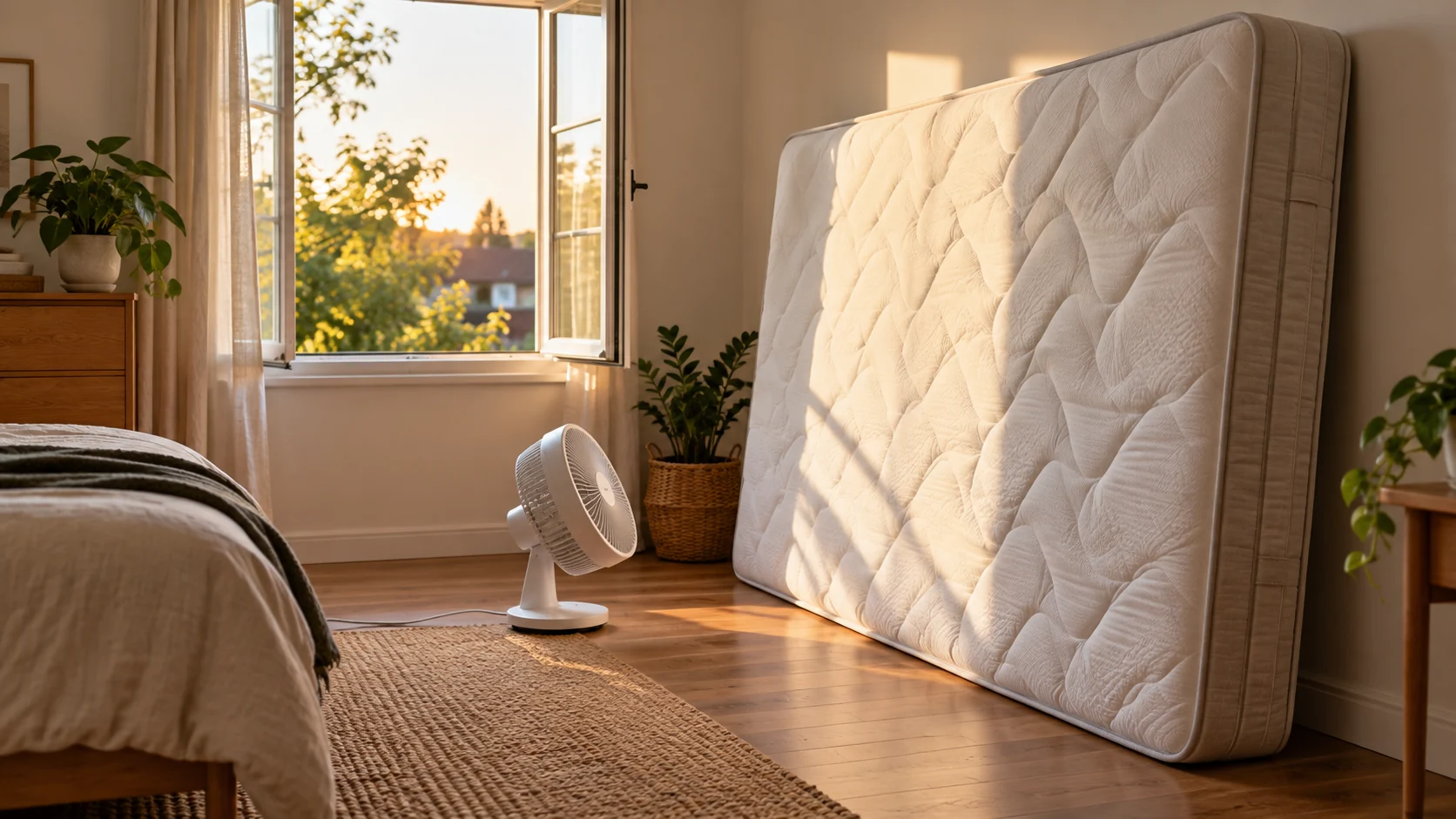
This is the step people rush, and it is the one that turns a solved stain into a smell problem. Count on six to twelve hours for a treated area to dry all the way through, longer in a basement or during a humid Montreal summer. A fan blowing across the surface halves that time and works far better than a space heater, which risks setting whatever is left.
If you can, stand the mattress on its edge while it dries: air then reaches both sides of the treated area.
Where we stand
A waterproof mattress protector costs a fraction of what a mattress does and makes half of this page unnecessary. It is the only cleaning-related purchase we recommend across the board. Beyond that, our mattresses are built in Saint-Leonard and designed to last 20 years, against the 7 to 10 common across the trade: a mattress built for that long deserves to have a stain handled properly rather than quickly.
For routine upkeep, see our guide on how to clean a mattress. For a urine accident the steps are different, and they are in our guide on how to clean urine from a mattress.
Frequently asked questions
Why is my mattress yellowing even though I use sheets?
Because ordinary cotton sheets stop neither sweat nor body oil: they let both pass straight through. Over a single night an adult loses enough perspiration for the build-up to become visible within a few months. Only a waterproof protector creates a real barrier.
Does baking soda remove stains?
It absorbs moisture and neutralises smells, which is useful, but it dissolves neither grease nor pigment. On a yellow ring, baking soda used on its own will do nothing visible. It belongs at the end of a treatment, never at the start.
Can you use a steam cleaner on a mattress?
We advise against it. Steam adds a great deal of water and a great deal of heat, and heat sets the proteins in sweat, blood and urine. You risk making permanent a stain that would have come out with a slower, colder method.
Should I have a mattress professionally cleaned?
We do not clean mattresses, so we have nothing to sell you here. A professional service makes sense for a badly soiled surface, or for someone who cannot move a mattress around. Just check which method is used: injection-extraction services put a lot of water in, and the drying is still your problem once the crew has left.
Does a stain mean the mattress needs replacing?
No, in most cases. A visible mark affects neither support nor lifespan. The real end-of-life signals are an imprint that no longer disappears, edges that collapse, or a smell that survives two properly done treatments. We set those out in our guide to how long a mattress lasts.
Does vinegar damage a mattress?
Diluted, no. White vinegar cut with water is safe for ordinary ticking and for foams. Just avoid using it undiluted, avoid it on natural latex, and do not mix it with peroxide in the same container.