How to Clean Urine From a Mattress: The 5-Step Method
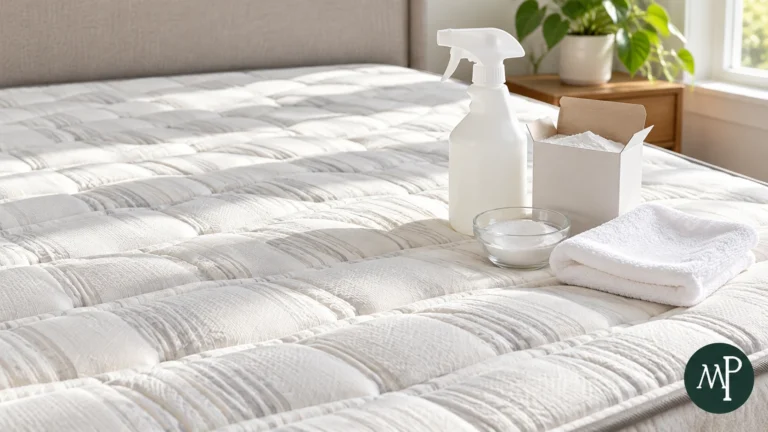
To clean urine out of a mattress: blot without rubbing, spray a solution of white vinegar and water, blot again, cover the area with baking soda and leave it for several hours, then vacuum. If the smell comes back a few days later, the urine soaked deeper than your treatment reached, and you need an enzyme cleaner.
We build mattresses, and we regularly take in mattresses ruined not by the accident itself but by the attempt to fix it. Too much water, a product that is too harsh, or careless drying does more damage than the urine did. Here is the method that works, and the moves that cost you a mattress.
The short version
- Move fast: fresh urine almost always comes out, dried urine needs an enzyme product.
- Blot, never rub. Rubbing drives the liquid deeper into the foam.
- Use as little water as you can. Trapped moisture is what creates the permanent smell.
- Baking soda absorbs, vinegar neutralises, only an enzyme cleaner breaks the residue down.
- Dry it completely before you put any bedding back on.
Why the smell always comes back
This is the question we get most often: the mattress smelled fine for three days, then the smell came back. The explanation is in what urine is made of. As it dries, it leaves uric acid crystals behind, and those are not water-soluble. You can wash the stain as many times as you like, the crystals stay where they are. As soon as there is humidity in the air, or simply the warmth of a body sleeping above them, they reactivate and the smell returns.
That is also why vinegar and baking soda are enough on a fresh accident but fail on an old one. They neutralise and absorb, they do not break anything down. To destroy the crystals you need enzymes.
Fresh urine: the full method
1. Strip the bedding immediately
Pull off the sheets, the mattress protector and any duvet, and start them washing while you deal with the mattress itself. Every minute wet fabric stays in contact with the surface lets more liquid travel downward.
2. Blot with a dry towel
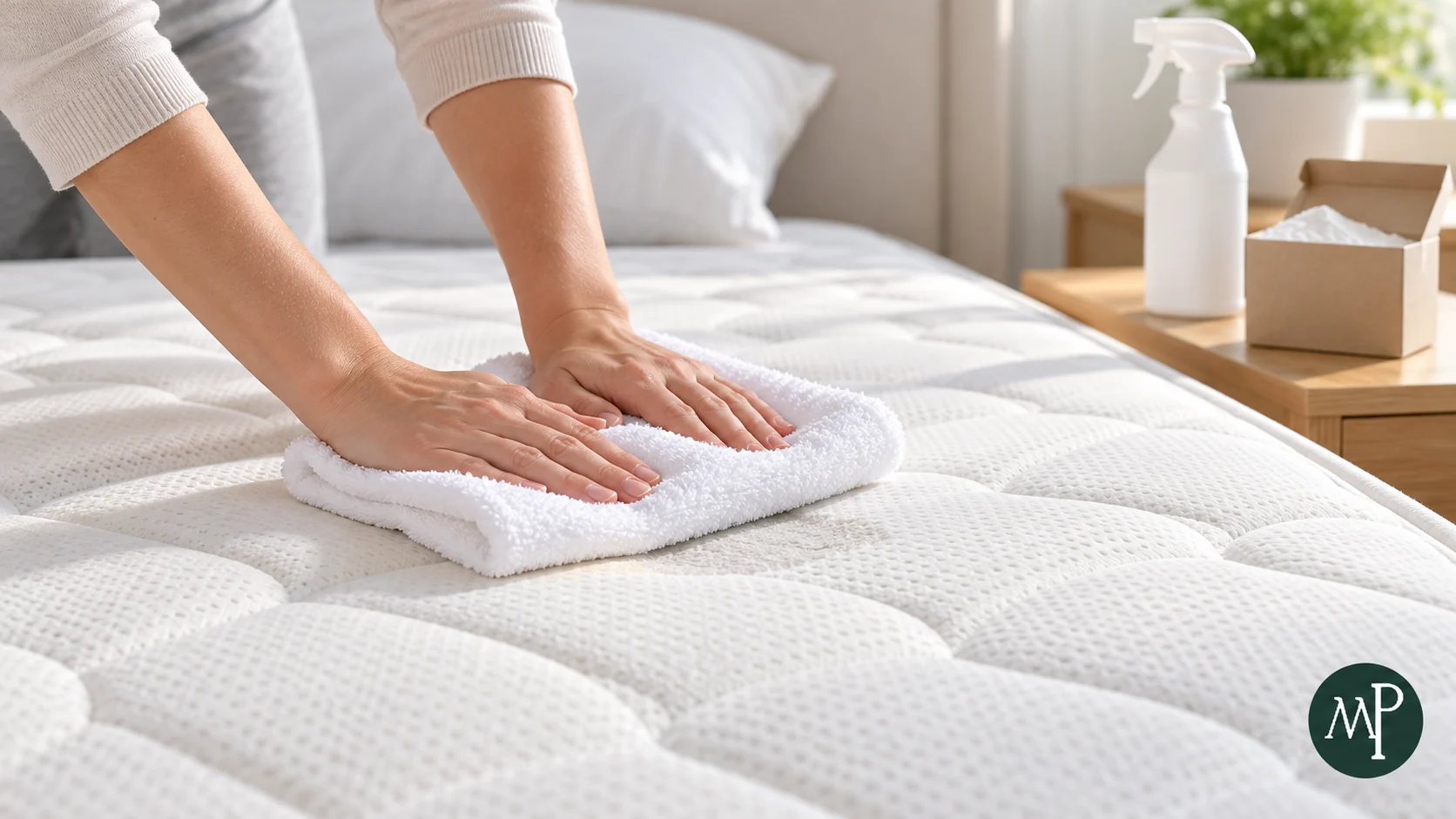
Press a clean towel flat over the area and lean on it with the weight of your hands. Repeat with a dry part of the towel until it stops coming up damp. Do not make any circular motion: you would widen the stain and push the liquid toward the core of the foam.
3. Spray vinegar and water
Mix equal parts white vinegar and cold water in a spray bottle. Mist it on lightly, just enough to dampen the surface of the stain. The temptation is to soak the area, and that is exactly what you must not do. Wait five to ten minutes, then blot again with a dry towel.
The proportions, so you do not have to guess: half a cup of white vinegar to one cup of cold water. If the stain is large, double the quantity rather than raising the concentration. Vinegar neutralises the ammonia and cuts the immediate smell; it does not deal with the underlying problem on an already-dry stain, and that is normal.
4. Cover it generously with baking soda
Sprinkle a thick layer of baking soda over the whole damp area, and do not be shy with it. The baking soda pulls the remaining moisture out of the foam at the same time as it absorbs the smell. Leave it at least five hours, and ideally overnight or a full day.
5. Vacuum, then dry it thoroughly
Vacuum up all the baking soda with an upholstery attachment, going over it several times and in two directions. Then open a window, or set a fan blowing across the surface. A mattress needs to be dry to the touch and dry underneath before a sheet goes back on, which usually takes longer than people expect.
Dried urine: you need an enzyme cleaner
If the accident is more than a few hours old, or if you have found an old yellow ring, vinegar will not be enough. Look for a product whose label mentions enzymes, or that is sold for pet odours. Those products contain enzymes that break uric acid down instead of just covering it up.
The point almost everyone misses: an enzyme product needs time and moisture to work. If you spray it and blot straight away, you have wasted it. Apply enough to dampen the area through the full depth of the stain, cover it with plastic wrap so it cannot evaporate, and let it work for several hours before you blot and dry.
An old stain sometimes takes two applications. That is normal, and it is always better than a single soaking one.
The peroxide recipe, for settled stains
If the yellow mark survives an enzyme treatment, there is a preparation professional cleaners have used for a long time: one cup of 3 percent hydrogen peroxide, three tablespoons of baking soda, and a single drop of dish soap. Mix it immediately before applying, because the mixture loses its effectiveness within about an hour.
Spray or dab it on lightly, let it air dry without rinsing, then vacuum up the powdery residue. Two precautions that matter: always test on a hidden corner, because peroxide bleaches, and do not use it on a natural latex mattress or on dark ticking. On pale fabric it is the method that gives the best results on old rings.
Pet urine is not the same problem
Cat and dog urine is more concentrated than human urine and carries scent markers your nose barely registers but the animal finds without difficulty. As long as those markers stay in the mattress, the animal is likely to return to the same spot. That is why enzyme treatment is not optional with a pet: it is the only way to erase the marker for good.
Avoid ammonia-based products on pet urine entirely. Ammonia is one of the components of urine, and its smell tells the animal the spot is already marked.
Urine is only one family of stain, and the others do not come out the same way. For blood, yellow rings, wine or body oils, see our guide on how to remove a mattress stain.
What you must never do
- Pouring water directly on the mattress, or putting it under a shower. The water reaches the core and never comes back out.
- Using bleach. It strips the colour from the fabric and attacks foams and adhesives.
- Scrubbing the stain with a brush. You open up the fibres and drive the liquid in.
- Drying it with a hot hair dryer or an iron. Heat sets the proteins and the stain becomes permanent.
- Putting a sheet back over an area that is still damp. That is how a musty smell takes hold.
How long drying takes
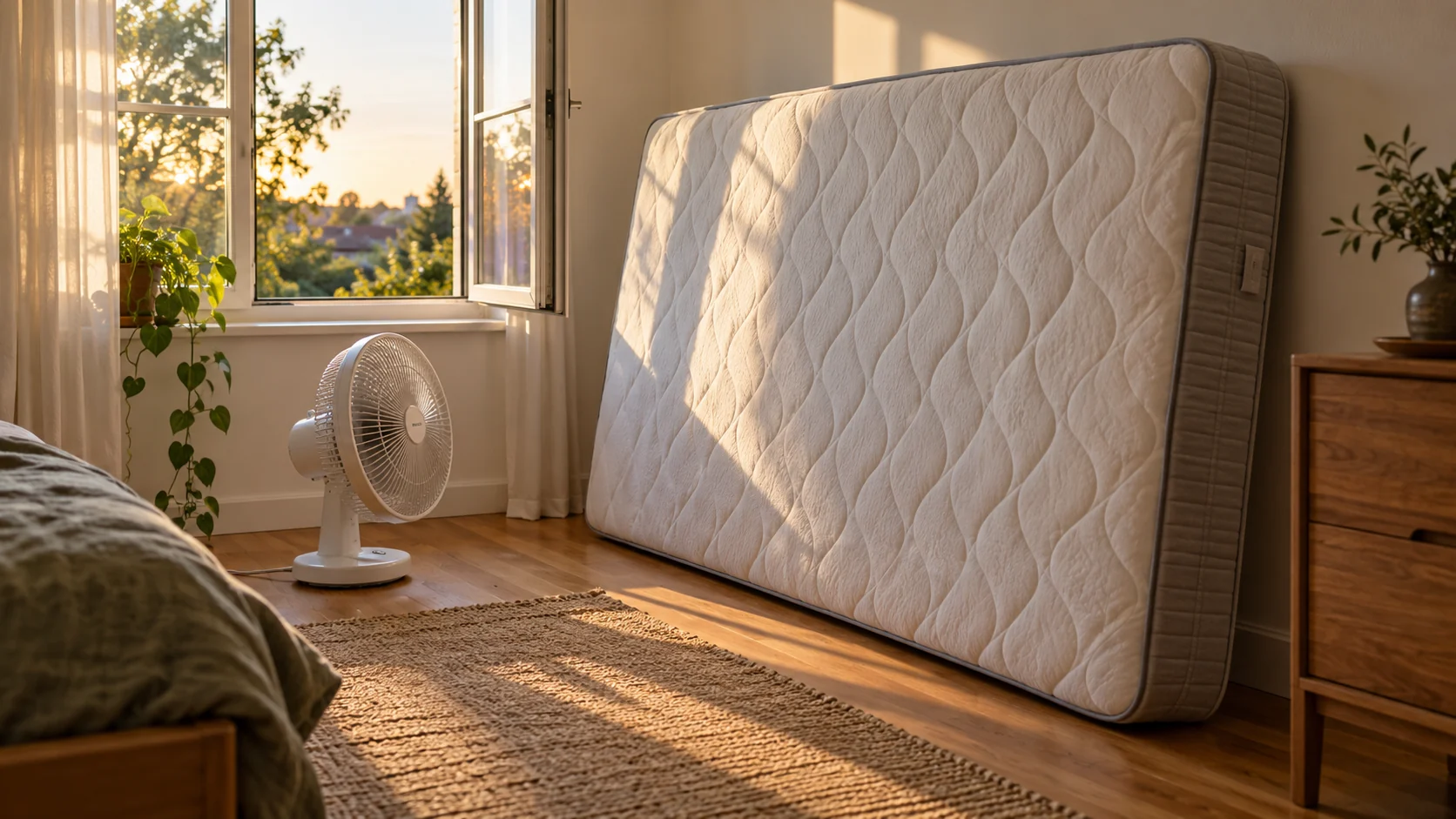
An area treated with vinegar and baking soda generally takes six to twelve hours to dry through, longer in a basement or during a humid Montreal summer. A fan blowing across the surface cuts that time roughly in half, and works far better than a space heater, which risks setting whatever is left.
If you can, stand the mattress on its edge while it dries: air then reaches both sides of the treated area.
A mattress protector solves this in advance
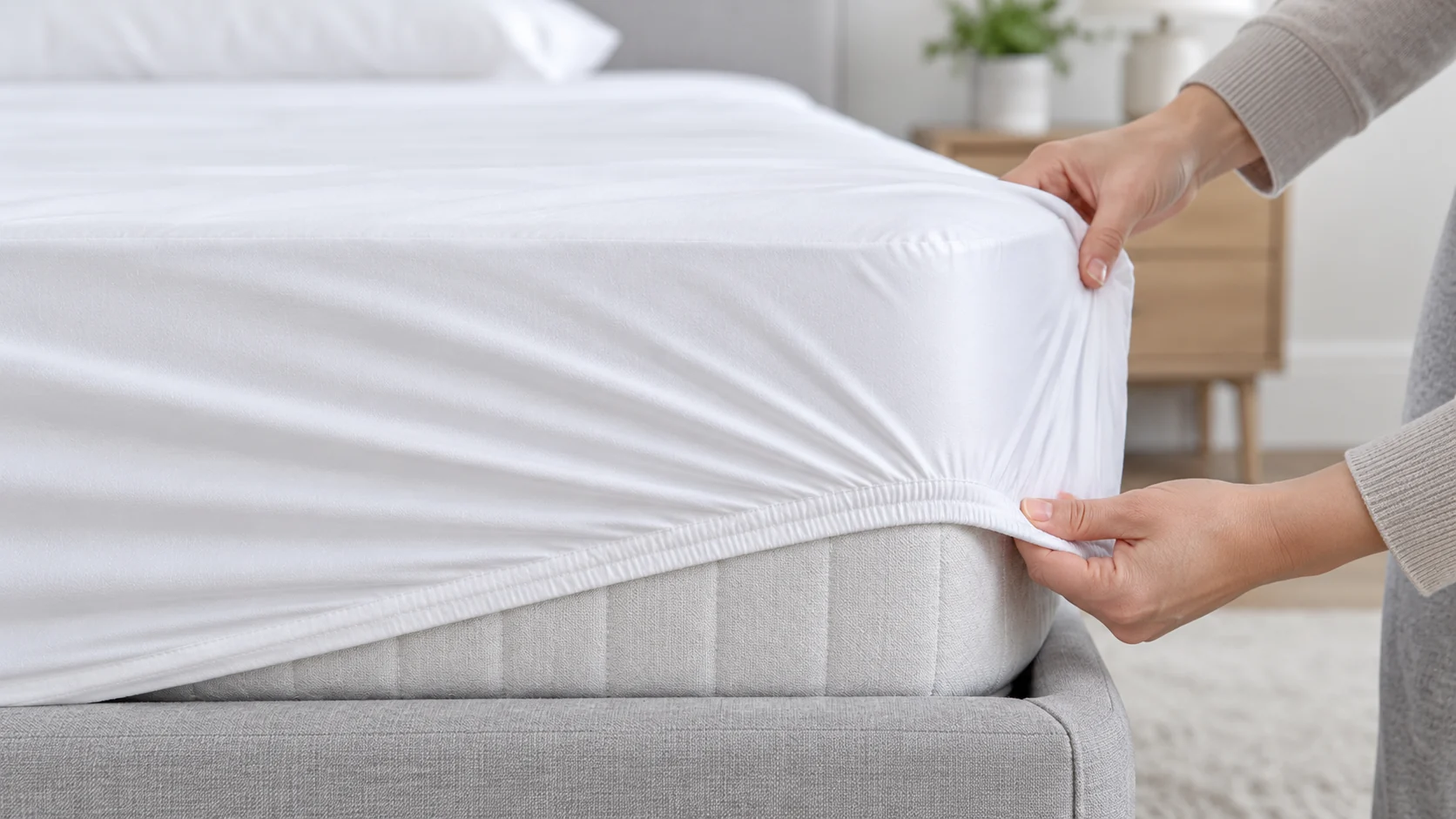
If there is a young child, an older adult or a pet sleeping on the bed, a waterproof mattress protector is what separates a ten-minute accident from a two-day one. It comes off and washes like a sheet, and it stops liquid reaching the foam, which is exactly where the whole thing is decided.
It is the only purchase connected to this subject that we recommend across the board, and it costs a fraction of what a mattress does.
When the mattress is past saving
There is a point beyond which cleaning stops being worth it: when the liquid has gone through to the foam core or the coil unit, when the smell survives two properly done enzyme treatments, or when an old stain has already started rusting springs. In those cases, what you are smelling no longer comes from the surface, and nothing applied on top will reach it.
If that is where you are, our guide to how long a mattress lasts will help you judge whether the rest of the mattress was worth keeping anyway.
Where we stand
We build our mattresses in Saint-Leonard and design them to last 20 years, where the usual lifespan across the trade is 7 to 10. A mattress built for that long deserves to have an accident handled properly rather than quickly. The method above costs you an evening; replacing a mattress costs considerably more.
For everything else in routine upkeep, see our full guide on how to clean a mattress, or call us at 514-725-1000 if you are wondering whether yours is still worth saving.
Frequently asked questions
Does baking soda remove the smell of urine?
On a fresh accident, yes, to a large extent: it absorbs the moisture and neutralises the smell at the surface. On a dried stain, no. Baking soda does not break uric acid crystals down, it covers them. That is why the smell comes back a few days later.
Can I use hydrogen peroxide?
On light-coloured fabric, yes, carefully, and always after testing on a spot that does not show. Peroxide bleaches, and on a dark or patterned ticking it will leave a pale mark more noticeable than the original stain. Dilute it, and never use it on a natural latex mattress.
How long can urine sit before it becomes impossible to remove?
There is no fixed deadline, but it gets considerably harder after the first twenty-four hours, the time it takes for the liquid to dry and the crystals to form. After a few weeks, plan on an enzyme treatment and on two applications rather than one.
Should I flip the mattress after an accident?
Only once it is completely dry, and only if it is a two-sided mattress. Flipping a mattress that is still damp traps the moisture between the surface and the base, which is the surest way to create a musty smell that really does not come out.
Is a steam cleaner a good idea?
No, not on urine. Steam adds a great deal of water and a great deal of heat, and heat sets the proteins urine contains. You risk making permanent a stain that would have come out with a slower method.
Does the yellow ring always come out?
The smell almost always goes with a properly done enzyme treatment. The visible mark does not always go, especially if it is several months old. A faint ring on a mattress that no longer smells and still supports you properly is not a reason to replace it.