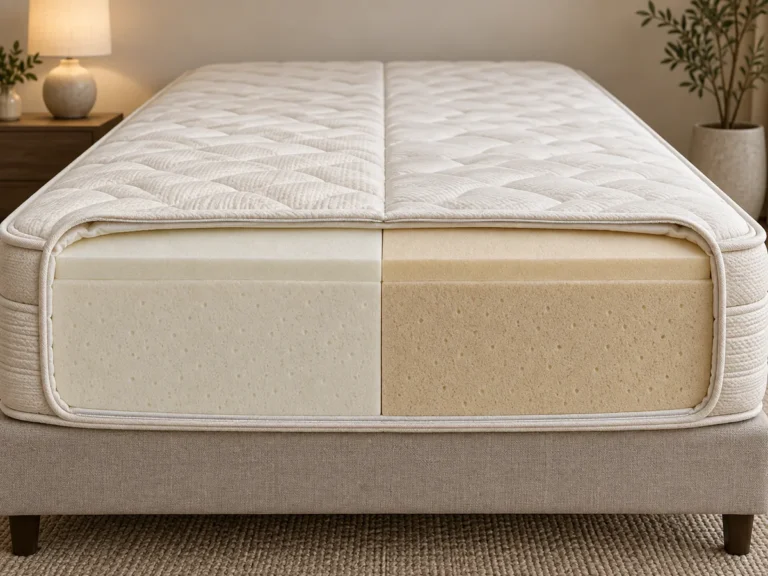
Latex, foam or coils: comparing the three builds
A mattress does two things: it supports you and it receives you. Support comes from the core, the welcome comes from the layers on top. Most disagreements about mattresses come from comparing one while thinking about the other.
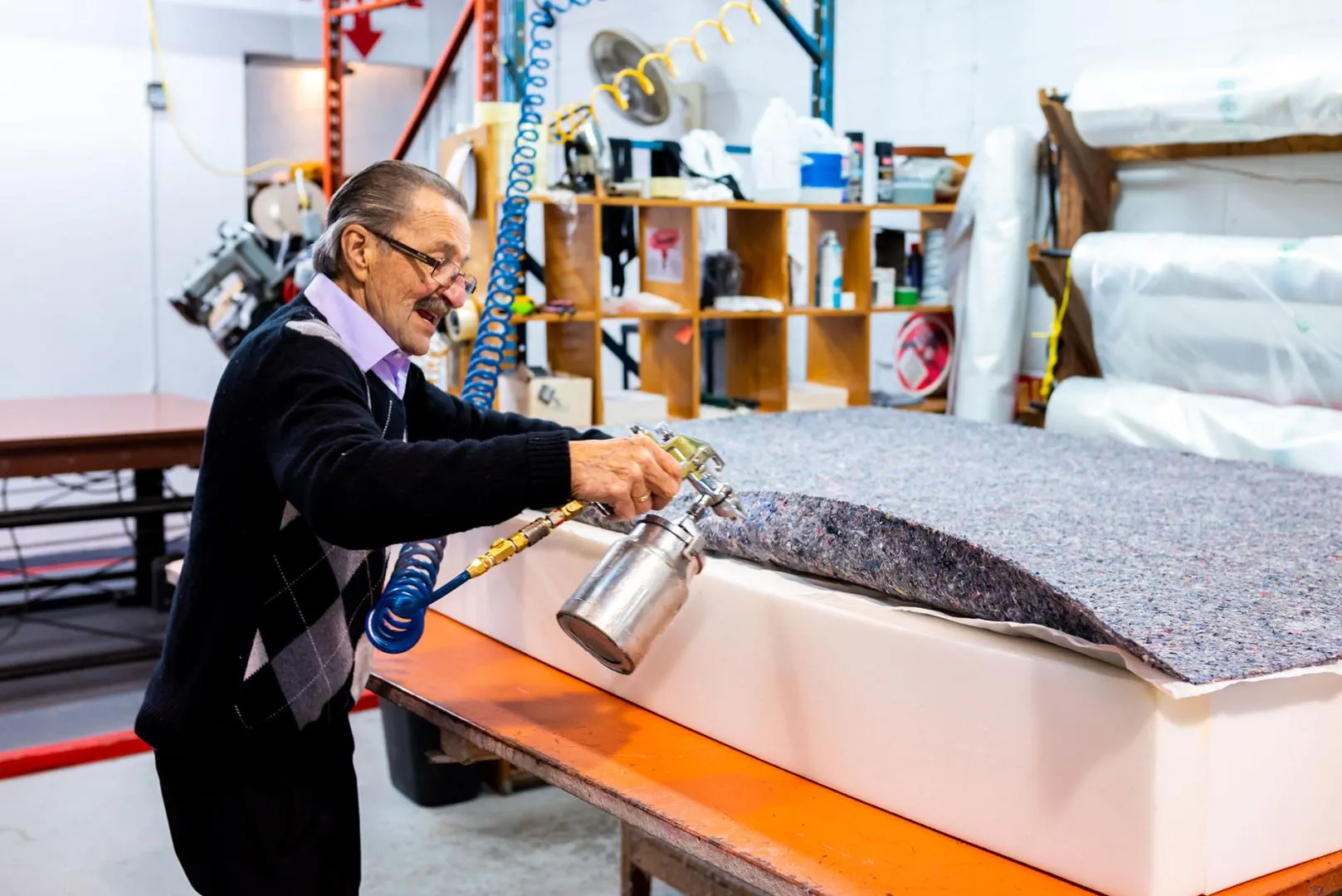
We build all three in our own workshop. Here is what genuinely separates them, without the brochure vocabulary.
Natural Talalay latex
Latex is the most elastic of the three materials. It returns to shape almost immediately, which gives you a surface that answers movement instead of holding it. If you have ever felt like you had to climb out of a dip to roll over, that is precisely the sensation latex avoids.
It also lets air move more freely than foam, which matters if you find your current mattress runs warm. It is the most expensive of the three materials, which is why it often appears as a surface layer rather than throughout.
See the latex mattress collection
High-density foam
Foam compresses gradually and releases more slowly than latex. That is what gives it a more continuous sense of support, without hard spots. Density is the number that matters: a dense foam supports for longer than a light foam of the same thickness.
It is also the quietest build and the simplest to look after. Across our range, foam bases run from three to six inches depending on the model, and that thickness explains most of the price gap between two models that look alike.
See the foam mattress collection
Coils
There are two families here, and they do not feel remotely alike.
Pocket coils. Each one is sewn into its own pocket and flexes on its own. That is what limits how much movement travels from one side of the bed to the other.
A continuous coil. It is made from one unbroken wire, so it flexes across a wider area. The mattress dips less in any one spot and the surface stays flatter.
Coils also move air by construction, since the core is largely open space. On our models the coil count is stated on each product page, because it is a verifiable figure rather than a sales argument.
See the innerspring mattress collection
And hybrids
A hybrid pairs a coil core with latex or foam layers above it. The idea is to get the motion independence of coils together with the welcome of latex. It is the most common build at the top of our range, and the one couples most often end up choosing.
See the hybrid mattress collection
How to decide
- Latex. You turn over often, or you find your mattress runs warm.
- Pocket coils or a hybrid. You feel the person beside you move.
- A continuous coil. You want a flatter, firmer surface.
- Foam. You want the simplest and quietest build.
One last point, and it applies to all three: the material tells you nothing about firmness. There are soft latex mattresses and very firm foam ones. Choose the build first, then the firmness.